Document Type : Original Article
Graphical Abstract

Highlights

The study provides a comparative analysis of the evolution of Quranic frontispiece design in Iran from the Abbasid to the Qajar period.
The frontispiece (Sar-Louh) represents a key element of Islamic illumination and manuscript art, reflecting Iran’s aesthetic development.
Findings show a transformation from simple rectangular frames to complex, crowned compositions across centuries.
Geometric, vegetal, and Chinese decorative elements gradually merged into Iranian illumination styles.
The Timurid era marked the peak of symmetry and visual refinement, while the Safavid and Qajar periods established the crowned frontispiece as the dominant form.
The overall evolution illustrates Iran’s continuous cultural and artistic adaptation within the Islamic artistic tradition.
A Comparative Study of the Form and Ornamentation of Quranic Frontispieces in Iran from the Abbasid to the Qajar Period
Abstract
The frontispieces of Qurans constitute one of the most valuable sources for tracing the evolution of manuscript illumination and book decoration across different historical periods. Through the examination of these frontispieces, it becomes possible to understand the stylistic development and transformation of Islamic book arts in Iran. The study of the ornamentation and gilding techniques used in Quranic frontispieces across successive eras provides a significant contribution to comparative research, particularly in determining the approximate date of undated manuscripts. This is crucial given that few dated Iranian Qurans from the early centuries have survived, and most information about them relies on secondary historical accounts. The primary aim of this research is to identify and compare the formal and decorative characteristics of Quranic frontispieces produced in Iran from the Abbasid to the Qajar period. It specifically addresses the question: How did the artistic and decorative styles of Iranian Quranic frontispieces evolve from the Abbasid to the Qajar era? This qualitative and comparative study analyzes 31 selected Quranic frontispieces preserved in Iranian and international museums and libraries. Documentary and visual analyses reveal that during the Abbasid period, surahs were typically separated by a rectangular band, often terminating with motifs resembling palm leaves along the margins. The earliest Qurans copied in Iran retained similar decorative patterns. The palm-leaf motifs, initially connected to the inscribed frontispieces, continued—with modifications in form and design—up to the 14th century CE (8th century AH). Over time, their prominence diminished, gradually shifting from the margins to the upper sections of the frontispieces. This transition ultimately paved the way for the development of crown-shaped frontispieces (sar-louh-e-tāji) characteristic of the late Safavid and Qajar manuscripts. Given that the tradition of Quran transcription and illumination was initially transferred from the Arab lands to Iran after the advent of Islam, it is reasonable to assume that early Iranian manuscript decoration followed the aesthetic conventions of its original centers. However, over time, these practices underwent notable transformations, eventually assuming distinctly Iranian artistic features in later periods.
1. Introduction
The illumination and decoration of the Quran has held a special place in Islamic art since the earliest days of Islam. From the very beginning, Muslims treated the divine revelation with deep reverence and respect. It was only natural, then, that they sought to beautify its pages with the artistic skills and styles of their time. When the Quranic script and its calligraphic traditions spread from the Arab world into Iran, the earliest examples likely followed the conventions of their homeland. Over time, however, these traditions began to change, adapting to the aesthetics and culture of their new environment. This gradual transformation gave rise to a uniquely Iranian form of Quranic art.
Decoration and ornamentation in Quranic manuscripts evolved into many different styles throughout history. Artists introduced rich patterns, vivid colors, and precious materials like gold and silver, all to highlight the sacred nature of the text. Every page was designed not only for clarity but also to evoke a sense of awe. One of the most recognizable features in this tradition is the headpiece, or frontispiece (sarlawh). Interestingly, the practice of illuminating sacred or religious texts has even earlier roots. The first known illuminated manuscripts are often traced back to the time of Mani (ca. 216–277 CE), the Iranian prophet and founder of Manichaeism. Mani and his followers produced intricately decorated books, using bright colors and gold leaf to enhance their calligraphy (Klimkeit, 2005: 72). Although no complete Manichaean manuscript has survived, scholars have discovered small fragments that reveal a variety of materials, layouts, and artistic techniques (Gulácsi, 2005: 59). In some of these works, the illumination fills the page margins, while in others, it spreads across the entire surface, blurring the line between decoration and illustration (Gulácsi, 1997: 191).
Previous research on Quranic illumination has largely focused on individual dynastic styles rather than a comprehensive chronological comparison. Notable studies include analyses of printed Qurans from the Qajar period (Bouzari, 2006), investigations into early illuminated folios in the Golestan Palace manuscripts (Mesbah et al., 2021), and examinations of ornamental structures in Seljuk and Timurid Qurans (Mirzaie & Kateb, 2023). However, this study distinguishes itself by tracing the visual and structural evolution of Headpieces from the Abbasid to the Qajar eras, highlighting the continuous transformation of design principles in Iranian manuscript art.
In the context of book decoration, a headpiece refers to a geometric design, often gilded and placed at the beginning of a manuscript. It usually includes motifs arranged around a central panel or cartouche that contains the title, the name of God, or another sacred inscription (Mayel Heravi, 1993: 676). Because Quranic headpieces represent both the refinement of Islamic art and centuries of Iranian creativity, they are an important part of Iran’s cultural heritage. Studying them helps us trace how Iranian artists combined faith and artistry to honor the divine word.
Therefore, this research adopts a descriptive-analytical approach based on documentary evidence. Its goal is to identify and compare the forms and motifs of Quranic headpieces created in Iran from the Abbasid period to the Qajar era. The study asks: How did the artistic and decorative methods used in Iranian Quranic headpieces change over these centuries?
Since few examples survive from before the fourth century AH, and considering the strong influence of Abbasid aesthetics in early Islamic Iran, the study first explores Abbasid-era Quranic designs. It then traces how these early models evolved into distinct Iranian forms, following their stylistic developments up to the Qajar period, examining changes in both form and motif along the way.
2. Research Methodology
The present study, based on its objective, constitutes a theoretical exploration grounded in documentary studies. The statistical population comprises images of Sarlawhs from Quranic manuscripts available in printed sources, official museum and library websites, and collections both within and outside Iran. Through purposeful selection, the authors have focused on some of the Sarlawhs from Qurans spanning the Abbasid to Qajar periods among a broader array of Iranian Islamic art headpieces. These details highlight a significant transformation in the form, style, and motifs of the examined headpieces relative to one another. Extracted data have been qualitatively processed using a descriptive-analytical method and a comparative approach involving diachronic observation (focused on studying various historical periods), converting them into documented information.
3. Results
3.1. Quranic Headpieces from the 1st to 4th Centuries AH
Quran illumination began in the Umayyad period to separate verses and indicate surah names, though no dated manuscripts survive (Ettinghausen & Grabar, 2000: 322). Early Qurans on parchment were horizontal to suit the large Kufic script. Common scripts until the 5th–6th centuries AH were simple Kufic (regular proportions, short verticals, bold horizontals for geometric order) and Iranian Kufic (Safadi, 2002: 10).
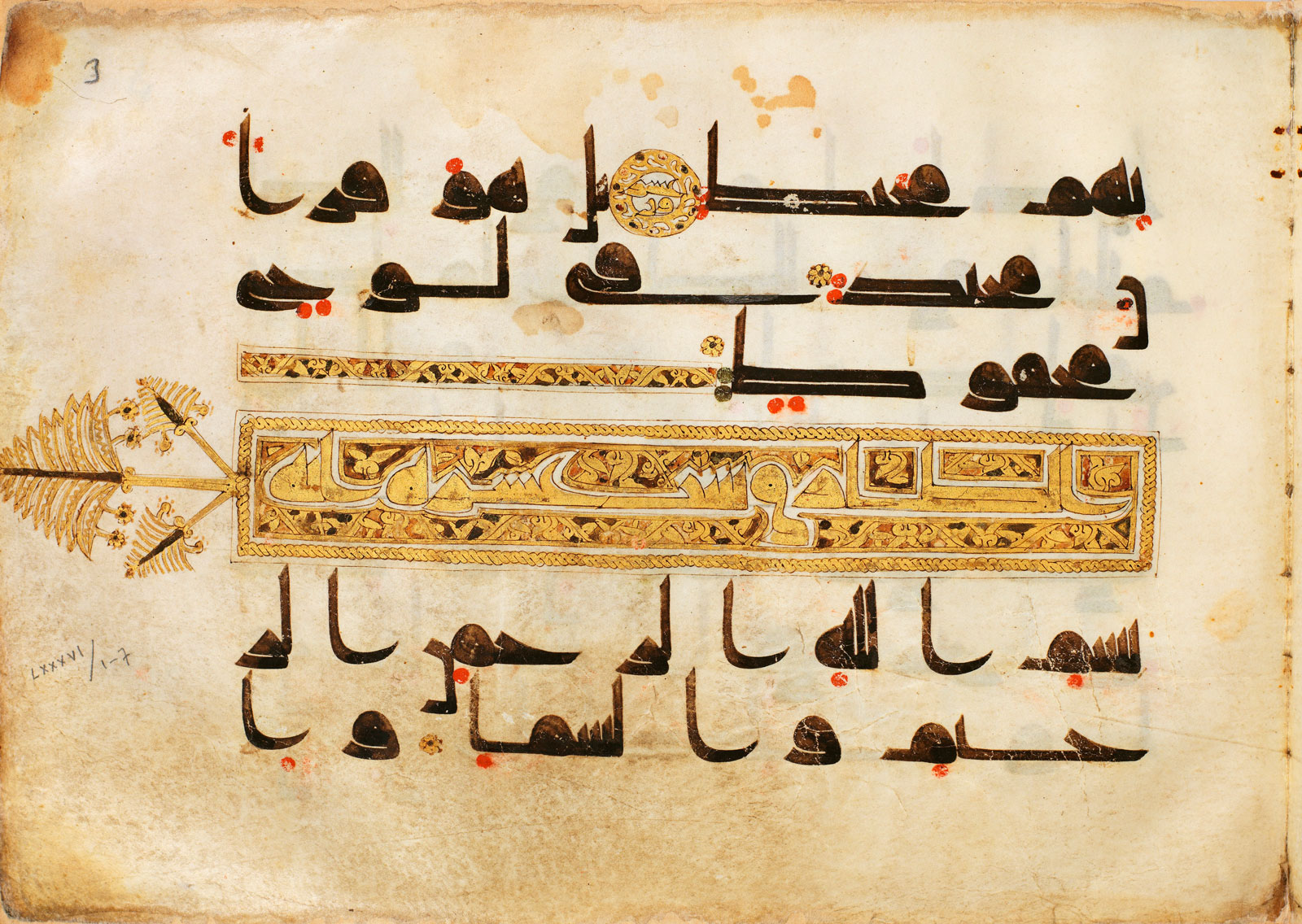
Surah and divine names were initially in colored or gold ink, later framed rectangularly with added decorations. Figures 1, 2, 3, and 4 show early Abbasid Kufic sections with inter-surah rectangular bands filled by swirling or mosaic motifs. Abbasid initial pages featured central rectangular frames, sometimes ending in flower-like or palm leaf margins. A 3rd-century AH example in Cambridge University Library has geometric-decorated rectangles; folios 2–3 end in a Toranj motif, with the opening line in a differing color linked to a palm leaf without an inscribed headpiece (Fig. 5).
Palm leaves are integral to early Qurans. The 3rd-century frame widened for surah titles; vegetal/palm decorations drew from Sasanian art, rectangular bands possibly from Roman tabulae ansatae (Ettinghausen & Grabar, 2000: 120–121). A late 4th-century AH paper Quran from Isfahan mirrors Abbasid styles but uses Eastern Kufic (Fig. 6); similar Iran/Iraq-attributed headpieces exist (Fig. 7).
Abū ʿAlī Muḥammad ibn ʿAlī ibn Muqlah (d. 272–318 AH) systematized six scripts in the 3rd–4th centuries AH and established Naskh in 310 AH, replacing Kufic (Monshiqomi, 1987: 10). Ibn Bawab (late 4th–early 5th centuries AH) pioneered elaborate headpieces. Figure 8 displays his swirling vegetal motifs around letters; compared to Ibn Muqlah's, it has richer margins. "One of these ornaments is merely a chain motif" (Jafari Dehkordi & Astaneh, 2021: 43).
|
|
|
|
Figure 1. Quranic headpiece in Kufic script, 2nd century AH. |
Figure 2. Quranic headpiece from the first century of the Abbasid period (Gacek, 2008:180).
|
|
|
|
|
Figure 3. Quranic headpiece in Kufic script, late 2nd to early 3rd century AH, Abbasid period, Museum of Turkish and Islamic Arts, Istanbul. |
Figure 4. Quranic headpiece in Kufic script, 3rd century AH, Abbasid period, Morgan Library and Museum. |


Figure 5. Two pages from the headpieces of a Quran book from the third century AH, Cambridge University Library.
|
|
|
|
Figure 6. Quran's headpiece on paper, Isfahan 383 AH (Khalili, 2002: 153) |
Figure 7. A page from the headpiece of the Quran written on parchment, 3rd century AH, Iraq or Iran, Museum of Ancient Iran (Lings, 1998: 21-25). |
|
|
|
Figure 8. Quranic headpiece in the handwriting of Ibn Bawab, late 4th century AH, Chesterbeattie Library. |
3.2. Quranic Headpiece from the 5th and 6th Centuries AH
Kufic became decorative from the 5th century AH, used in calligraphy, epigraphy, and vessel adornment (Shayestefar, 2010: 17). A 5th-century AH decorative Kufic Quran page in the Metropolitan Museum has a blue-filled inscribed headpiece outlined without decoration, ending marginally; extended alifs swirl-decorated, flower motifs above text (Fig. 9). ʿUthmān ibn Ḥusayn al-Warrāq's 5th-century AH Eastern Kufic Quran in Astan Quds Museum features an inscribed headpiece with a circled star ending in a pointed Toranj motif (Fig. 10).
Another Metropolitan 5th-century AH Quran uses decorative Kufic for basmalah (Fig. 11); surah heading in inscribed headpiece ends in large flower motif (Figs. 12 and 13), sometimes from circles (Fig. 14). A fine Seljuk Quran in the University of Pennsylvania Museum has gold-illuminated opening pages with a central lotus, overlapping lozenges/semicircles; another folio's inscribed headpiece has a vegetal/filled-circle surah surround, Toranj termination (Fig. 15).
A Seljuk Qarmati paper headpiece uses four-line Eastern Kufic with pointed alifs; background filled with swirling vegetal motifs appearing incised, echoing Seljuk architecture (Fig. 16). A similar Seljuk Quran is in the Metropolitan Museum. Palm leaves persist with size variations, connected to pointed Toranjs or small top ones. Initial pages gold-sprinkled with geometric motifs; Iranian Kufic used in headpieces and text.
|
Figure 10. A page from a Quran with decorative Kufic script, 447 AH. Astan Quds Museum (Blair, 2006: 197). |
Figure 9. A page from a Ghaznavid Quran with decorative Kufic script - 5th century AH. Metropolitan Museum.
|
|
Figure 12. A page from a Quran with decorative Kufic script, 5th century AH. Large flower towards the margin, Metropolitan Museum. |
Figure 11. A page from a Quran with decorative Kufic script, 5th century AH. Metropolitan Museum. |
|
Figure 14. A page from a Quranic manuscript in Eastern Kufic script, written on parchment, Seljuk period, large circular flower border. |
Figure 13. A page from a Quran with decorative Kufic script, 5th century AH. parchment, large flower to the margin, Harvard Museum. |
|
|
|
|
Figure 15. Quranic manuscript from the Seljuk period, Museum of Anthropology and Archaeology, University of Pennsylvania.

Figure 16. A page from a Seljuk period manuscript - 7th and 8th centuries (663-756 AH) (Canby, 2009a: 203).
3.3. Quranic Headpieces in the 7th and 8th Centuries AH
Book decoration surged post-Mongol conquests, yielding large-format illustrated works from the early 8th century. Baghdad illumination continued despite instability. Ilkhanid Mongols supported Iranian calligraphy, advancing scripts for later eras (Kianfar, 1997: 24–29). Late 7th–early 8th-century AH Rabʿ-i Rashidi near Tabriz influenced illumination; large Quran formats enabled polygonal geometrics.
A thirty-part Quran folio by Aḥmad ibn Suhrawardi, illuminated by Muḥammad ibn Aybak (Metropolitan Museum), has a vegetal-swirl frame corner-connected to a pointed Toranj pattern (Fig. 17), resembling 5th-century ʿUthmān ibn Ḥusayn al-Warrāq (Fig. 10) but with smaller Toranj and vegetal over geometric. A rare 7th-century AH Boston Museum page separates verses via basmalah/horizontal extensions; an imaginary rectangular frame from lines; negative space introduces surah (Fig. 18).
|
Figure 18. Headpiece of a 7th-century AH Quran, Museum of Fine Arts, Boston. |
Figure 17. Headpiece of the final page of an Ilkhanid-era Quran, written in 708-701 AH, Metropolitan Museum of Art. (Blair, 2006: 248). |
|
|
Figure 19. Headpiece of an Ilkhanid-era Quran, Dublin, Chesterbeattie Library (Lings, 1998: 127).
|
||
|
Figure 20. Headpiece of an Al-Jaytu Quran, Mosul, 710 AH (Kadoi, 2009: 225).
|
||
|
Figure 22. Title page of an Ilkhanid-era Quran, 739 AH. (Canby, 2009a: 168). |
Figure 21. Headpiece of an Ilkhanid-era Quran, calligraphy and illumination by Abdullah ibn Muhammad al-Hamadani, National Library of Cairo (Lings, 1998: 127). |
|
|
Figure 24. Headpiece of a Quran from the 8th century AH. Shiraz (Khalili, 2001: 148). |
Figure 23. Headpiece of a Quran from the 8th century AH. Shiraz (Khalili, 2001: 132). |
|
3.4. Quranic Headpieces in the 9th Century AH
The Timurid rule initiated a new book decoration era in the late 8th century AH, Herat and Shiraz, focusing largely on non-religious manuscripts. Timurid opening/preface headpieces are complete, symmetrical, and page-encompassing, with soft, rounded subdivisions contrasting prior geometrics (Rahnavard, 2009: 82).
The "four-panel" headpiece, used around the 7th century AH, flourished Timuridly; named for four cartouches on facing pages. Some view paired headpieces as misnamed, actually four-panel. Mongol innovation placed dual texts (main/margin): an inscribed headpiece for the main, a parallelogram for the margin (Safari Agh Qaleh, 2011: 306–307) (Fig. 25).
Late Timurid headpieces favor natural floral/bush motifs; orderly, with marginal Toranj s/geometrics (Fadaei Tehrani, 2004: 53). Palm leaves/connected flowers decline post-Timurid, yielding to almond Toranjs beside/above. Almond Toranj emerges mid-8th century AH on inscribed headpieces, peaks Timuridly, fades late 9th; Shiraz characteristic (Fig. 26) (Safari Aq-Qaleh, 2011: 302).
|
|
|
Figure 25. Two pages from Ibrāhīm Sulṭān (796–838 AH), Timurid-era Quran, Metropolitan Museum (URL) |

Figure 26. A page from the Quran from the Timurid period, 834 AH, Shiraz, scribe Ibrahim Soltani (Lings, 1998: 176).
3.5. Quranic Headpieces from the 10th to 12th Centuries AH
Safavid headpieces, Timurid-inspired, evolved: rectangle topped by semi-Toranj "crown," wide-bordered, cartouche-connected. Form refined over time, dominant late Safavid/Qajar with mostly crowned headpieces (Rahnavard, 2009: 98). Semi-crowns start 8th–9th centuries AH; early Safavid feature a central top crown, horizontal-line-enclosed side decorations (Safari Aq-Qaleh, 2011: 341) (Figs. 27, 28, and 29).
Qajar crowned headpieces widely decorate Qurans and manuscripts, sized according to the ruling/illumination. Heightened vs. prior eras, page-top-extending, illuminated on one/two facing pages (Fig. 30).
|
Figure 28. Page from the Safavid Quran (Lings, 1998: 192). |
Figure 27. Two pages of the Safavid Quran, Harvard Museum (URL). |

Figure 29. Crowned headpiece (Taj) from the Safavid period, 979 AH (Khalili, 2002: 206).

Figure 30 Crowned headpiece from the Qajar period, Aga Khan Museum (Canby, 2009b: 45).
4. Findings and Discussion
The evolution of Quranic headpieces progresses from simple inscribed structures with palm leaf motifs in early periods, to more complex geometric-decorative compositions in intermediate periods, and ultimately to architectural-style and crowned headpieces in the Safavid and Qajar eras. This transformation reflects shifts in visual taste, advancements in illumination techniques, and the incorporation of regional and intercultural styles in Iranian book decoration.
Subsequently, the developmental trajectory of Quranic headpieces from the 1st century AH to the Qajar period is examined in terms of calligraphic features, frame structure, and decorative motifs.
4.1. 1st–4th Centuries AH
Initially, surah titles were indicated without frames, distinguished only by size and color in Kufic script. Gradually, a rectangular inscribed band was added to emphasize the title. At the end of this band, a simple, repetitive palm leaf motif was placed, one of the earliest decorative elements in headpieces. In the latter half of this period, with the prevalence of Naskh script, the cartouche and palm leaf became more integrated and vertically oriented on the page. Iranian examples are scarce and primarily share roots with Abbasid ones.
4.2. 5th and 6th Centuries AH
In this period, the palm leaf motif evolves in shape and varies in size. Occasionally, a pointed Toranj or a small semi-Toranj is added above the inscribed band. Opening pages, especially introductory ones, are decorated with gold sprinkling and regular geometric motifs. Iranian Kufic is used alongside Naskh, and the headpiece structure remains simple and symmetrical.
4.3. 7th and 8th Centuries AH
Crenellations are added to headpieces, noticeably increasing their height. Toranjs and decorative flowers connect to the cartouche. Geometric paneling and polygons become prevalent in large-format Qurans, with Chinese elements (cloud bands, curved leaves, soft knots) entering illumination. This period leads to expanded compositions and diverse headpiece forms.
4.4. 9th Century AH
Rigid geometric and polygonal motifs fade, with a growing preference for curved surfaces and softer forms. Palm leaf motifs gradually diminish, replaced by almond- and oval-shaped Toranjs in the center or on both sides of headpieces. Four-panel headpieces stabilize and reach peak cohesion and refinement in the Timurid period.
4.5. 10th–12th Centuries AH
Headpieces acquire axial symmetry and architectural structures. In the early Safavid period, facing headpieces appear as symmetrical pairs across two pages. Crowned headpieces (increased height with a peak-like shape at the top) gained popularity from this period and became dominant and distinctive in the Qajar era. In the late Safavid and Qajar periods, decorations became more delicate, with warmer and more varied colors. Table 1 illustrates these changes in a phased and comparative manner, indicating that headpieces evolved from simple, line-oriented initial structures to more complex and decorative compositions in later periods.
Table 1. Schematic illustration of the changes in form and pattern in the sar-loh of the Quran from the early centuries until the Qajar period
|
Date |
The Headpieces of Quranic Manuscripts (Sarlawh) |
|||
|
Early centuries until 4 A.H |
|
|
|
|
|
5th and 6th century A.H |
|
|
|
|
|
8th and 7th centuries A.H |
|
|
|
|
|
9th century A.H |
|
|
|
|
|
10th to 12th centuries A.H |
|
|
|
|
5. Conclusion
Historical evidence and Manichaean remnants show that Mani and his followers shaped pre-Islamic Iranian book decoration and illumination. Gold, vibrant colors, and harmonious compositions in Manichaean books reflected Iranian taste, enabling continuity and evolution in the Islamic era. With Islam and Quranic expansion, Iranian aesthetic elements, illumination, and calligraphy techniques were applied to early mushafs, reframed religiously.
By comparing the surviving frontispieces (sar-loh) from the 4th century AH, the influence of Abbasid decorative styles on Iranian frontispieces can be observed, accompanied by changes such as the use of Eastern Kufic script. The early frontispieces, similar to those of the Abbasid period, were of the inscriptive type, containing the name of the surah, and often ended in palm-leaf and medallion motifs extending toward the margins. From the late 4th century AH, the use of floral motifs can be seen in Quranic frontispieces copied by Ibn al-Bawwab.
Geometric patterns, often in intricate compositions combined with vegetal motifs, appear in Seljuk frontispieces and reached their peak during the Ilkhanid period in large-format Qurans, though their prominence declined in later eras. Chinese decorative elements were also incorporated into Ilkhanid frontispiece designs. In the 8th century AH, battlements or crenellations were added to the upper part of the frontispiece, increasing its vertical dimension. In illuminated Shiraz frontispieces of the Ilkhanid era, a small triangle attached to the corner of the frame can be observed, a feature less common in earlier periods but widely used in the Timurid and Safavid periods.
The “four-panel frontispiece” (chahar-loh), dating to around the 7th century AH, was often employed in manuscripts, particularly in non-Quranic texts, and became especially popular during the Timurid period. In the late Timurid era, there was a noticeable tendency toward naturalistic designs, with floral and foliate motifs used in Quranic frontispieces. Palm-leaf and floral ornaments continued to appear until the Timurid period, but gradually gave way to almond-shaped (Toranj) placed beside or above the frontispiece. These almond-shaped medallions appeared from the second half of the 8th century AH and gained great popularity during the Timurid period, though their use declined toward the end of the 9th century AH.
During the Safavid period, a major innovation appeared: a crown-like element (Taj) was added to the top of the frontispiece, surrounded by a wide border that connected to the inscription panel below. This overall form underwent further refinement and became the most popular and widespread type during the late Safavid and Qajar periods, in which crowned frontispieces became predominant.
Acknowledgement
The authors would like to thank Dr. Mohsen Mohammadi Achacheloui, Mr. Gholamreza Panahi, and Dr. Monireh Moradi for their constructive suggestions.
Conflict of Interest
The authors report no conflict of interest. Financial Support: This research was conducted without any financial or non-financial support.
Financial Support
This research was conducted without any financial or non-financial support.
Authors' Contributions
The first author was responsible for the ideation, initial data collection, comparative analysis, and writing the original draft. The second author performed scientific editing and structural improvement. The third author handled data and writing updates, image curation, conceptualization, and analysis refinement.
Access to Materials and Data
The data of this research will be accessible through correspondence with the author.