
Document Type : Original Article
Graphical Abstract
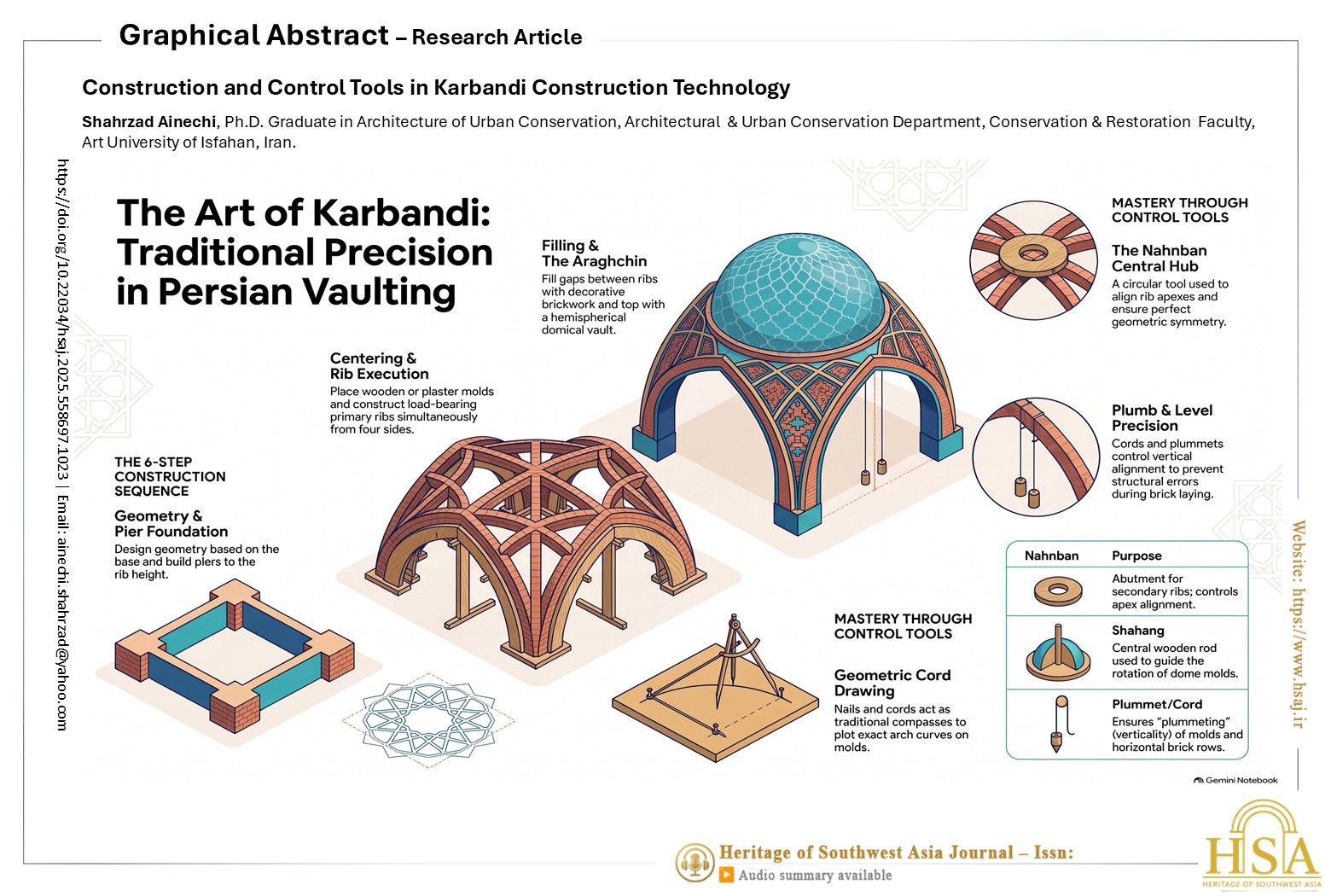
Highlights

· For the first time, this study documents, introduces, and field-analyzes the traditional execution and control tools and methods utilized in vertical-mold karbandi vaulting within the historic Tabriz Bazaar, grounded in the oral teachings of traditional master builders.
· The research delineates the four-part structural framework of karbandi, comprising primary load-bearing ribs (tavizehs), secondary ribs (lenghehs), infill components (fillers), and the domical cap (araghchin), while clarifying the structural load-transfer mechanics of each component.
· The construction sequence of vertical-mold karbandi vaults is codified into a six-step process, spanning from base geometry design and pier erection to centering placement, primary rib construction, secondary rib assembly, and final domical cap execution.
· The precise application of the circular control tool known as the nahnban, along with its 24 equal radial divisions, is detailed as a technique for locating the geometric center, maintaining radial symmetry, and verifying the horizontal alignment of secondary rib apexes.
· Traditional geometric control techniques, including the use of plumb lines, level hoses, double-ended cords weighted with quarter bricks, and mortar measuring sticks, are documented for regulating vertical plumbness, horizontal leveling, and brick joint uniformity.
· Bricklaying methods and patterns are analyzed across structural elements, including radial (Rumi), pitched (Zarbi), and mixed bondings in primary ribs, alongside mitered (Farsi-bar), herringbone/interlocking (Khofteh-rasteh), and diagonal (Pa-to-pa) arrangements in infill panels and domical cap techniques.
· The empirical findings demonstrate that while the overarching geometric principles and construction sequence of karbandi remain consistent across traditional master builders, specific execution details vary according to master experience and practical job-site conditions.
1. Introduction
Karbandi is the structure of a kind of roofing, consisting of secondary ribs with a certain arched form that interlock according to certain geometrical (Bozorgmehri, 2006). In Persian Architecture, Karbandi has been used for different purposes; in some cases, it has been used as a secondary roof under the main roof to bring a sense of geometric beauty and order into architectural spaces. In other cases, it appears at the stage of transferring a quadrilateral base to a dome and beautifully facilitates the transition. And in a few other cases, it has played the role of the main cover of space, and apart from the decorative effect, forms the main skeleton of the roof (Koliji, 2012). Karbandi is constructed of brick, gypsum, and mortar mixtures.
Past architects, familiar with the knowledge of geometry and the ability to practice geometric relationships, sought to confirm the theoretical geometric methods with their tools. Nowadays, the use of very precise tools, which are based on the knowledge of mathematics and geometry, leads to the proper construction of the Karbandi. Accurate and exact construction requires careful control. The accuracy of the construction process with the control tool will be re-examined by the master builders, and the necessary reforms will be carried out, and final approval will be obtained from them. Lack of control of the plummeting of centering during the construction of the karbandi causes errors in the transfer of the geometry of the karbandi and the intersection points of karbandi ribs on the centering. Also, it is very important to control the horizontal alignment of brick rows and the arc apex of secondary ribs during construction. Otherwise, brick rows will meet at a point other than the arc apex, and the geometry of the proper karbandi is not constructed. By incorrectly dividing the centering curve to pick bricks, there may be no room for running the keystone anymore. The purpose of this paper is to investigate how to use control and construction tools to increase accuracy and precision in the construction of karbandi. In this regard, the following research questions are raised as follows:
1- What steps do you take to construct the karbandi?
2- How has the process of controlling the construction of karbandi in traditional architecture been?
3- How can new techniques such as drawing 2D designs and 3D modeling of Karbandi show the role of control and construction tools in the construction process?
There was no sign of Karbandi before the third century AH (Bozorgmehri, 2006). The first Karbandi having been recognized in Iran dates back to the Saffarid dynasty in the Jame mosque of Shiraz (262 AH, ninth century AD), which is older than that of Córdoba in Spain (tenth century AD) (Michell & Grube,1978). Karbandi can be studied from different dimensions such as geometric, structural, and space-making, which has attracted the attention of various researchers and master builders. Of these, some mention the history of the emergence of the use of karbandi (Burckhardt, 2009; Wilber & Hold ,1995; Sharbaf, 2006). Most of the researchers who have discussed the issues related to the karbandi have only tried to draw them traditionally (Bozorgmehri, 2006; Raeisi & Tehrani, 2013; Sharbaf, 2006; Raeisi et al., 2013).
This research aims to discover geometric relationships and principles of Karbandi to regulate and facilitate its design process in contemporary architecture (Amjad Mohammadi et al., 2019). The purpose of this paper is to identify and discover the geometric relationships between Rasmi and Akhtari Karbandi based on actual examples (Amjad Mohammadi & Shahbazi, 2020).
Some authors have also proposed new drawing methods based on mathematical formulas: (Mohammadian & Bemanian, 2018; Pour Ahmadi, 2014; Garofalo, 2016; Mohammadi & Ebrahimi, 2018; Ainechi & Valibeig, 2020; Garofalo, 2016; Mohammadian et al., 2018). In the meantime, researchers have presented materials about naming and categorizing different types of karbandi based on their plan shape, structure, or facade. Some of these papers have clear diagrams and drawings outlining the geometry of Karbandi types (Mohamadian Mansoor & Faramarzi, 2011).
With limited resources, the technology of karbandies is mentioned (Ainechi & Valibeig, 2020; Mohamadian Mansoor & Faramarzi, 2011). This thesis examines how material interactions in situ shape design knowledge in architectural practice (Kendir-Beraha, 2015). In this paper, for the first time, with field studies and using the opinions of local master builders, constructive details and how to control the construction of the karbandi in the rectangular base are presented.
In this article, for the first time, the tools for implementing and controlling the accuracy of karbandi construction are introduced in written and modeled form.
The lack of thorough study of these tools has caused structural and architectural errors in the restoration of some examples. The present article, considering the mentioned scientific vacuum, intends to facilitate the process of construction of karbandi geometry in the contemporary world by introducing the use of different tools.
Several control and construction tools are currently used in the same traditional method in the construction of Karbandi elements.
The research method, based on the goal, is considered a practical study. Part of the research process is based on the study and analysis of the contents and references contained in the written sources, and on the other hand, part of the research process is based on field observations and objective investigation of works on the site. In this paper, we have tried to introduce, analyze, and better understand the tools for controlling and constructing karbandi and their features by presenting appropriate photos and maps. The portfolios of karbandi under construction in Tabriz Bazaar have been geometrically analyzed and modeled.
All stages of the formation of these karbandi ribs were recorded and documented by observing the architects during the construction of some karbandi samples. During the construction of the samples, the traditional architects explained the details of the process, such as how to construct karbandi components, brick arrangement, the use of centering, how to use control tools, etc. At least fifty samples of different karbandi constructions with various geometrical shapes were investigated in small spans (3*3 m) to large spans (15*15 m). The authors were present at the workshops during the construction of 20 samples of these karbandies. Attending the workshops specific for karbandies restoration and personal observation of them were effective in gaining a deep understanding of the karbandi construction. Six local master builders were interviewed in Tabriz city and four masters in Isfahan. These local architects have constructed various karbandies using traditional methods in different areas of Iran.
There are the most diverse numbers of karbandi with masonry construction technology in Tabriz and Isfahan. Also, the number of traditional master builders who have the capability of designing and constructing the karbandi in these cities is more than in other ones.
Based on the original fieldwork involving a series of interviews conducted with specialist master builders in the field of karbandi construction, including Mohammad Molazadeh in Tabriz and Mohammad Paknejad in Isfahan, the samples were redrawn and modeled in the software.
The methodology is sufficiently explained using new diagrams and images such that someone else knowledgeable about the field could repeat the study.
Karbandi is a kind of overlay structure of different architectural bases that has four main parts: 1) Primary rib 2) Secondary ribs 3) Fillers 4) Araghchin (domical vault)
Structures are called karbandies whose ribs' skew backs are placed lower than the arc apex. Studies show that the secondary ribs must withstand their load, fillers, and araghchin.
1) Primary rib: The primary rib is a curved beam that transfers the vault loads to load-bearing pillars or walls.
2) Secondary rib: These are parts, one or two legs of which are placed on rib skewback, primary ribs, or other secondary ribs. Ribs play mostly the role of main load conductor and distributor from masonry ribs to the columns or other elements.
3) Fillers: After the construction of the primary ribs and secondary ribs at the distances that arise from the intersection of the primary ribs and the secondary ribs from the lowest level to the place where the domical vault begins, various forms arise. These shapes are always filled with bricks (in rare cases with clay) in different ways. In some cases, this section is lined with plaster.
4) Araghchin: From the highest point of intersecting ribs to the apex of the arch is filled with a hemispherical or 1/4 spherical shape. This part is called araghchin.
Step 1: For karbandi construction, one should design karbandi geometry based on the underlying base and placement point of piers, where the ribs are settled on. One of the main issues related to the design of karbandi is that, due to its geometrical structure, it is not possible to design any desired karbandi on a given base. Therefore, the designer must be able to discern the proper karbandi for a given base.
Step 2: The main piers are constructed based on the plan until the height of the rib's skewback.
The size of these piers depends on the vault size of the karbandi. The larger the main span, the thicker the piers will be.
Step 3: The centering is placed on the main pillars. The centering rib is a temporary wooden or chalk structure built to support an arch during construction. Thin wooden centering or plaster ribs are used only in smaller bays (less than 6 m). Load-bearing wooden centering makes it possible to employ different methods of brick arrangements in the larger bays (up to 10 m).
Step 4: Construction starts from all four sides at the same time. The construction of the load-bearing ribs starts after centering.
Step 5: Firstly, several main and load-bearing ribs are constructed with masonry materials, then the remaining ribs are attached to them. After the construction of the first row, the next rows on one side of the back layer of the first row are fixed for support. One or two parallel primary ribs are constructed first, and then the perpendicular or transverse intersecting secondary ribs are built. In karbandi, with the use of primary ribs and secondary ribs, the loads are directed in specific directions to reach the piers.
Step 6: Then the gaps between primary ribs and secondary ribs are filled with brick, and in some cases, these gaps are divided into smaller parts (Fig.1, Fig. 2, Fig. 3, Fig.4, Fig. 5, Fig. 6)
|
|
|
|
|
|
|
|
Load bearer primary rib is usually constructed in the radial brick vault, the pitched brick vault, and in a combination of these two methods. To increase the firmness and transverse ability of the primary rib, a mixture of the pitched-brick vault and radial brick vault methods is used. First, 1/6th of the span is constructed with a radial brick vault, then a pitched-brick vault is constructed.
The difference between the hidden mixed method and the explicit mixed method is that, beneath the primary rib is only the radial brick vault shape is seen, and those bricks laid out in the pitched-brick vault method are not seen in the hidden method. But in the explicit mixed method, the primary rib is seen in a pitched-brick vault shape. In the mixed method, the thin brick row constructed in the pitched brick vault method, whether in hidden or explicit form, plays the role of the frame for the primary rib, preventing the vault collapse until the completion of the work (Ainechi & Valibeig, 2020).
In the Karbandies, the primary rib is constructed only in a pitched brick vault and a mixture of the hidden method. Then, the back of the first course is filled with other courses to support the square bricks placed in parallel next to each other with a pitched brick vault arrangement (Fig. 7, Fig. 8, Fig. 9).
7. The methods and techniques of bricklaying in the facade are very diverse. Bricks can create thousands of combinations because of their geometric shapes and variety of sizes.
8. In the end, khafteh rasteh, mitered joint, and pa to pa techniques are used to fill the empty spaces of karbandi elements (kite shapes and stretched kite shapes).
8.1. Introducing the fillers of Karbandi:
1. Sineh Baz or Soosani: In the oblong traditional Karbandies, to link the work with the Shamseh or Khorshidi (Solar) in the center of the work, an intermediary part is required, which the one-legged or two-legged works would fit in the air; this part is called Soosani (Memarian & Safaiepour, 2012).
2. Pa-barik is a long lozenge-shaped component with two long and two small sides.
3. Shaparak or Toranji: small lozenges which have a more symmetric side with respect to the linear axis of the shape.
4. Sanbooseh: It is constructed in the space between two sides of the Shaparak and the base of the Araghchin; a triangle will be formed, which we refer to as Sanbooseh .
5. Samseh or khorshidi: It is a formation similar to the sun, which is obtained from the combination of Sanboosehs under the calotte.
6. Domical vault or Araghchin: It is a covering that is put on the Sun of Karbandi.
1. Fillers between the primary ribs (kite-shaped, stretched kite-shaped, toranj)
2. Fillers between the secondary ribs and the primary ribs (soosani)
3. Fillers between the two sides of the kite-shaped and domical vault (Fig.10-1 & Fig. 10-2).
v Construction of the domical vault with gypsum centering:
Gypsum centerings, which are taken as guides to arch curves, are placed in vault diagonals. These centerings are placed in such a position that they can be picked up after the construction. After filling the gaps between the gypsum centerings with bricked shells, the domical vault is completed (Memarian & Safaiepour, 2012) (Fig. 14).
v Construction of the domical vault with rounding method:
After converting the quadrilateral or octagon to the base of the vaulting circle, its domical vault becomes like a rounding dome. In the rounding method, bricks tend toward a center (Memarian & Safaiepour, 2012) (Fig. 15).
v Construction of the domical vault with ribs similar to the primary ribs:
In some cases, ribs similar to the primary ribs in the shell (domical vault) section are used. These elements are not considered secondary ribs and are not included in the main definition of the karbandi (Fig.16).
In the manufacture of main primary ribs and secondary ribs, two instruments are used: 1- Construction tool and 2- Control tool. Construction tools (meters, screed, centering, nail, cord, etc.) are used to construct main primary ribs and secondary ribs. The control tool (plumb, screed, cord, level, set square, nahnban, etc.) is used to control theoretical geometry and transfer it to practical geometry, especially its alignment in terms of plumbing. Sometimes the only control tool while running is the manufacturer's eye.
Using ropes or cords instead of compasses is the oldest method used in Ancient Egypt to construct architectural proportions and drawings (El-Said et al., 1993). The arch geometry of the desired karbandi is also drawn by nail, cord, and screed and cut on the centering. From the deployment of nails at points A and B and a pencil at point C, and during turning the cord around these points, the karbandi arc is drawn (Fig. 17).
|
|
|
|
Figure 18: Use of wooden centering in the construction of secondary rib (Source: Authors)
|
Figure 17: How to construct the arch shape on the mold (Source: Authors)
|
Traditional centering was made with wood or plaster. Today, many centerings for a variety of reasons, such as non-breaking or deformation, are made with Square steel profile number 3 or 4, particle board, or steel corner profile. Both primary ribs and secondary ribs’ centerings are connected around by harnesses to prevent them from moving while picking bricks (Fig. 18).
The temporary gypsum centering is made of gypsum and straw. Gypsum is the forming shape, and straw is its bone. At first, half of the desired arch is drawn on the ground. Parallel to the first profile, at a distance of 10 to 15 cm, draw another profile. When drawing lines, bricks are arranged so that the distance between the two curves remains empty. Separators such as sand and nylon are used to prevent the plaster centering from sticking to the ground. Then they place the straws in the mold and put two gypsum Grouts on it. After drying, half of the mold is obtained, and the other half is performed in the same centering. To obtain two halves of a full, complete, and uniform arch, they used a half-centering. After completing half of the gypsum karbandi rib, they made the second half exactly like the first shape and in the same format (Fig. 19 & Fig. 20).
In this method, after performing the shahang (wooden rod) on the inner shell apex, at its base section, at the bottom, and on the top of it, they construct a roller to rotate the wooden centering; they run the wooden centering base on the rollers and the arc apex on the shahang, and with the rotation of the wooden centering, the dome with the desired arch is constructed. The rotating centering shows the correct direction in advance.
Shahang is a wooden rod and is placed in the center of the dome. Shahang is tightly closed on several sides so that it does not moved, then on two points where there should be two ellipse foci, two studs are nailed to the Shahang and attached to those two very delicate chains with which to draw the desired ellipse. This chain is the same norm. The dome builder was picking from behind the dome and controlled the curve of the dome with a chain, which had to be smooth and precise from the inside (Fig. 21).
Used to find two aligned points in a building, especially for long distances. For example, level hoses are used to control the alignment of the pillar to deploy secondary ribs (Fig. 22)
When constructing centering for load-bearing main primary ribs, plumb and cord are used to ensure that the arc and mold are aligned. Two screed layouts by rule and line, plumb, and cord hang from the head of the mold. The extension of the plumb cord, with a 1 mm distance of string between the two columns, causes the mold to plummet. Molds are connected around by harnesses to prevent them from moving while picking bricks. The thickness of the brick and the size of the bonds between bricks on the mold are marked by a springer and end at the front of the springer. Plumb is performed 10 cm lower than the springer (Fig. 23, Fig. 24, Fig. 25).
|
|
|
|
Figure 23: Controlling the plummeting of the mold using a level (Source: Authors)
|
Figure 22: Using a level hose to control horizontal alignment (Source: Authors)
|
The thickness of the brick and the size of the bonds between bricks on the mold are marked from a springer and end in the front springer (Fig. 26).
|
|
|
|
Figure 27: Using nail and cord to control the alignment of the horizontal course of bricks (Source: Authors) |
Figure 26: Measured wood size (Source: Authors)
|
To control the horizontal alignment of the brick row when making primary ribs with the radial brick vault arrangement method, a rope with two heads tied to two-quarter bricks is used (Fig. 27).
After performing the primary ribs, to install the nahnban in its correct and accurate location, tie two cords from the primary ribs' apexes so that they intersect at point O from about 1 meter above the scaffolding, where the Nahnban is hung (Fig. 26 & Fig. 27). To construct, for example, 12 karbandi, the nahnban circle is divided into 24 equal parts by a protractor, line, and set squares.
Hanging a plummet from the center of the nahnban, the extension of the plummet cord, at a distance of one mm from the intersection of the cord between the four primary ribs, determines the correct location for installing the nahnban. Nails are installed along the radius of the nahnban, which numbers 24 (Fig. 28, Fig. 29, Fig. 30).
|
|
|
|
|
Figure 30: Connecting the nahnban to the wooden scaffolding (Source: Authors) |
Figure 29: How to locate the nahnban in the right place
|
Where the plumb hangs from the Z point, and the diagonal cord tied from the O point cuts each other off, the point of deployment of the second rib is on the primary rib (H point). We mark the H point on the primary rib, from point H to point E and G, where the dividing points are on the nahnban’s circle, tied with the cord. Repeating the same thing on four sides, the cording is complete (Fig. 31 & Fig. 32). Gypsum secondary ribs are installed in the corded site according to the karbandi map with fully plumb alignment. After the establishment of half molds, the positioning of the other molds requires knowing the location of their intersection with semi-molds. To find the confluence of the disconnected secondary rib AU cross on the MB secondary rib, first, a vertical plummet hangs from the MB secondary rib and attaches a cord from point A to the T point; the location of their confluence shows the cross point of both secondary ribs on the MB secondary rib (Fig. 33 & Fig. 34).
In small openings, for example, three meters, wood is placed in the middle of the primary ribs, and the cord is attached from the middle of the wood to the point of gravity or the center of the polygon with a plumb. The cord should be twisted around, and the distance from the apexes should be the same (Fig. 35 & Fig. 36).
To properly deploy bricks and control their curvature on the inside as fillers, today they use bars, and in the past they used thinner branches of the tree.
To construct karbandi, after drawing the geometry of its base, the type of arch is selected, and wooden or gypsum centering is constructed. The heavier the brick centering arrangement, the thicker the centering will be.
After the centering is formed and controlled vertically with cords and plumb, the construction of the primary ribs begins. Secondary ribs are then deployed on the primary ribs. After constructing the secondary ribs that form the bearing skeleton, the inner shells are placed among them.
Based on the size of the span, primary and secondary ribs have different thicknesses. The mixed method is used in the vaults with larger or middle bays due to enjoying higher resistance. In the last step, the domical vault is placed on the karbandi ribs.
The brick alignment of the fillers and domical vaults varies depending on the architect’s taste and available materials in different karbandies.
One of the most important points that should be observed during construction is controlling the horizontal alignment or vertical levels. For example, in the construction of the karbandi, the alignment of the brick row, the horizontal alignment of the apexes of the secondary ribs, plummeting off the piers, etc., should be reviewed through the control tool and the builder’s eye. Also, in the manufacture of the domical vault, wooden centering is used to run the arch of the dome properly. Nails and cords are used to control the alignment of the horizontal brick row, apexes of secondary ribs, and the construction of arch geometry on wooden or gypsum centering.
2D drawing and 3D modeling of Karbandies were conducted in AutoCAD based on field observations and comments from master builders for a better understanding of traditional methods of Karbandies design and implementation construction. All procedures conducted in the control and construction phases were modeled with high accuracy to reveal the role of these tools and techniques. The findings of the authors revealed how these tools can be used in different phases of construction and implementation procedures to control construction phases. Different modeling instruments, such as software, were used to reveal the role of such tools.
Appendix
Domical vault: The domical vault is a type of vault, such as a dome. This place is the highest part of the karbandi.
Level: A control tool that shows the smoothness of a surface. The vertical level is used to control the vertical and plumb the executable columns, and the horizontal level is used to control the horizontal alignment in the floor.
Screed: Screed is divided into two types: wood and metal. Screeds are used to control the plumbness of vertical surfaces.
Set-squares: A device consisting of two perpendicular sides. Set-squares are used to control the verticality and perpendicularity of the two extensions. Or, controlling the vertical angle of the two levels was done using a nail and cord. With nails and a cord, they formed a right triangle with sides 3, 4, and 5.
In contrast, long levels are used for vertically plummeting side angles and alignment of horizontal rows of brickwork.
Nahnban: It is a circular tool that was used in the past as an abutment for secondary ribs and to control the alignment of their apexes.
Pronunciation of Persian words
Shamseh /ʃæmseh /
Pa to pa /pɑːtuːpɑː/
Nahnban /næhænbæn/
Shaparak/ ʃɑːpæræk/
Toranj /tɔːrænj/
khorshidi /khoʊrʃɪdɪ/
Sinebaz /sɪnnebɑːz/
Soosani /suːsænɪ/
Araghchin /æræg t͡ʃɪn/
Shahang /ʃɑːhæŋ/
Khofteraste /khʊʃtɜːrɑːstɜː/
No data, models, or code were generated or used during the study (e.g., opinion or data-less paper).


