
Document Type : Book Review
Graphical Abstract
Highlights

· This work consolidates scattered data and reports regarding the Kalmākarra Cave objects across various museums and private collections accumulated over more than two decades of research.
· Researchers adopted an interdisciplinary approach by synthesizing archaeology, epigraphy, art history, and historical geography to reconstruct the historical context of the assemblage.
· Deciphering the Elamite inscriptions on the artifacts enabled the identification of the lost local kingdom and land of "Samati" during the late Neo-Elamite period.
· All artifacts have been systematically documented with technical specifications, decorative motifs, and a standardized photographic catalogue to serve as primary reference research data.
· Stylistic analysis of the objects clarifies the interaction between Elamite and Assyrian artistic traditions and their continuity into the early Achaemenid period.
· The detailed scientific documentation serves as an authoritative reference for authentication and a legal document in international courts to pursue the repatriation of looted artifacts.
1. Introduction and Significance of the Subject
Kalmākarra Cave, located in the southern part of Lorestan Province, is recognized as one of the most significant archaeological sites in Iranian archaeology and art history owing to its exceptional assemblage of silver and other metal artifacts attributed to the late Neo-Elamite period. Beyond their remarkable artistic and technological value, these objects occupy a distinctive position in the study of the cultural and artistic developments of the latter half of the first millennium BCE because of their Elamite inscriptions, the diversity of artifact types, and the outstanding quality of their metal craftsmanship. However, the accidental discovery of the cave in 1989 (1368 SH) and its subsequent extensive looting resulted in the destruction of much of the assemblage's archaeological context and the dispersal of the objects among museums and private collections both within Iran and abroad. For several decades, this situation severely hindered comprehensive and systematic research on the treasure, forcing scholars to rely on scattered reports, limited photographic documentation, and unevenly accessible information.
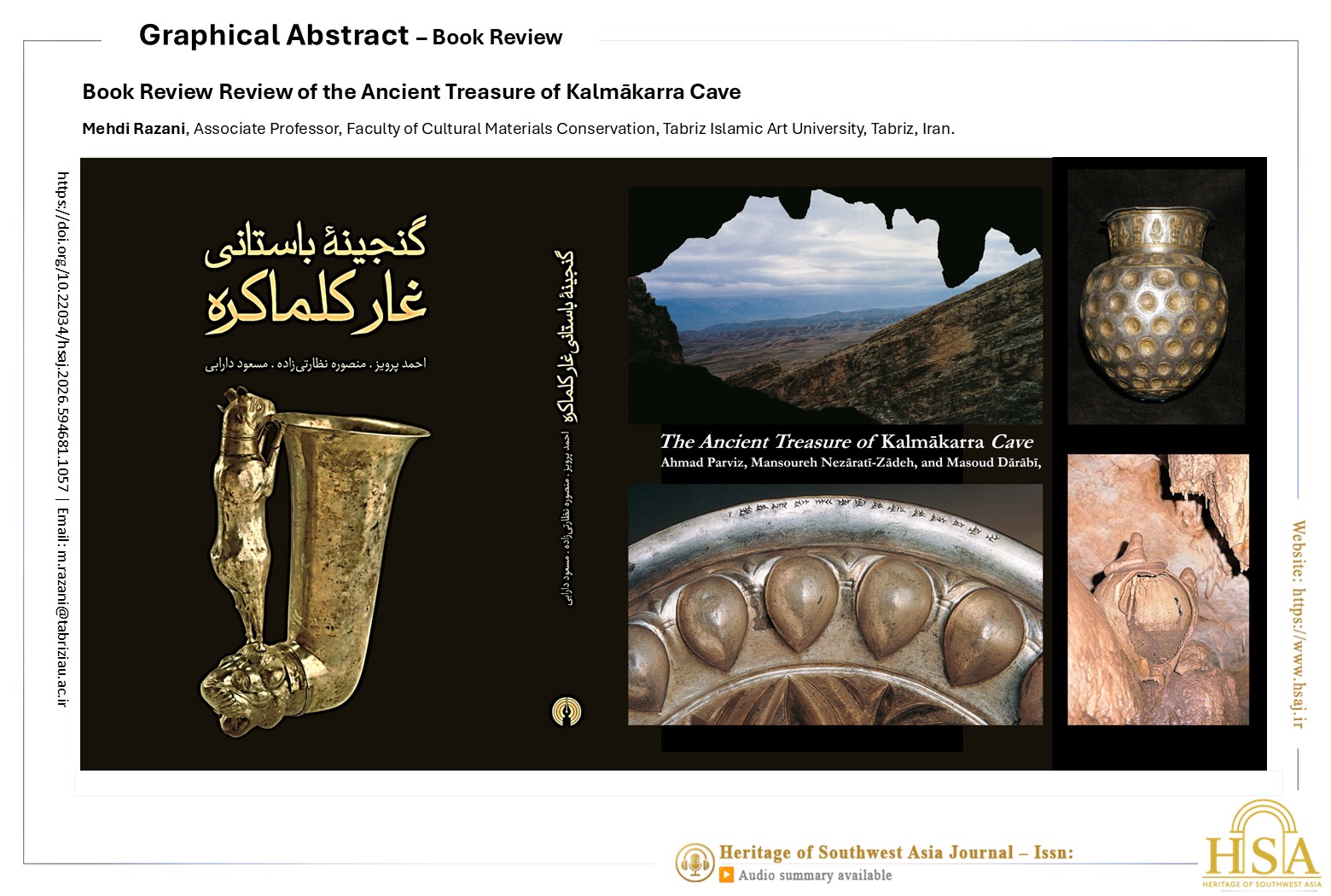
Against this background, the publication of The Ancient Treasure of Kalmākarra Cave by Ahmad Parviz, Mansoureh Nezāratī-Zādeh, and Masoud Dārābī represents a significant contribution toward consolidating and systematizing the available evidence relating to this remarkable assemblage. The volume is the culmination of extensive field investigations, documentation, and specialist studies undertaken by the authors on artifacts attributed to Kalmākarra Cave. By integrating archaeological evidence, epigraphic research, art-historical analyses, and comparative studies, the book reconstructs the historical, cultural, and artistic context of the treasure in a coherent and comprehensive manner. In addition to presenting and describing the artifacts, it examines the circumstances of the cave's discovery, the subsequent dispersal of the collection, the interpretation of the Elamite inscriptions, and the stylistic characteristics of the objects, thereby providing a renewed understanding of the assemblage within the cultural transformations of the late Neo-Elamite period and the formative stages of Achaemenid art.
One of the book's most distinctive strengths is its systematic documentation of the artifacts. In the third chapter, each object is presented through detailed technical records accompanied by high-quality, standardized photographs. This rigorous documentation elevates the volume beyond a conventional catalogue, transforming it into a well-documented corpus of primary research data available to the scholarly community. Such documentation provides an invaluable foundation for comparative studies, art-historical research, investigations of ancient metallurgical technologies, archaeometric analyses, and assessments of the authenticity of objects attributed to Kalmākarra Cave.
The present review aims to introduce and critically evaluate this publication by examining its contribution to the fields of Iranian archaeology, ancient Iranian metalworking, and cultural heritage conservation. To this end, the review discusses the book's structure and contents while assessing its scholarly achievements, methodological innovations, limitations, and potential for future research, thereby clarifying its significance in advancing interdisciplinary studies of Iran's cultural heritage.
2. Book Overview and Structural Analysis
The Ancient Treasure of Kalmākarra Cave was published in 2025 by Elm va Farhang Publishing House. The volume is the culmination of more than two decades of research on a corpus of artifacts attributed to Kalmākarra Cave. The project began with the documentation of objects housed in the Falak-ol-Aflak Museum in Khorramabad and was subsequently expanded through the examination of artifacts preserved in the National Museum of Iran and other recognized collections. According to the authors, the principal objective of the book is to compile, organize, and critically analyze information that had previously been scattered across archaeological reports, scholarly publications, and museum collections, but had never before been brought together in a single comprehensive volume.
The conceptual framework of the book is based on the premise that the investigation of an archaeological treasure whose original context has been severely compromised cannot rely solely on the surviving material remains. Rather, it requires the integration of archaeological evidence with epigraphic studies, art-historical research, historical geography, and comparative analyses. Accordingly, the authors examine the Kalmākarra artifacts not as an isolated collection of individual objects, but within their broader historical, cultural, and artistic context. This interdisciplinary perspective moves the volume beyond the conventional format of a museum catalogue, transforming it into a scholarly study in which systematic documentation serves as the foundation for historical interpretation.
The book's three-chapter organization reflects this methodological approach. The first chapter examines the natural, geographical, and historical characteristics of the region, providing the contextual framework necessary for understanding the significance of Kalmākarra Cave within the cultural developments of the Zagros Mountains. Rather than treating the cave merely as the findspot of the artifacts, the authors situate it within regional settlement systems, communication networks, and cultural traditions. This contextualization enables readers to appreciate the environmental and historical background of the assemblage before engaging with the artifacts themselves.
The second chapter is devoted to the discovery of the cave, the subsequent looting, the dispersal of the collection, and the recovery of individual objects. The significance of this chapter, however, extends beyond reconstructing the historical sequence of events. By documenting the consequences of illicit excavations and the illegal trafficking of antiquities, the authors clearly demonstrate how the loss of archaeological context has fundamentally constrained the scholarly interpretation of the assemblage. In addition, the presentation and analysis of the Elamite inscriptions, together with an examination of their relationship to the land of Samati, open new perspectives for understanding the historical and political significance of the treasure during the late Neo-Elamite period. These discussions establish the interpretative framework for the systematic presentation of the artifacts in the following chapter.
The third chapter, which constitutes the core of the volume, is dedicated to the systematic documentation and presentation of the artifacts attributed to Kalmākarra Cave. Each object is treated individually and accompanied by detailed information concerning its dimensions, physical characteristics, iconography, inscriptions, decorative features, current repository, and other catalogue data, together with high-quality, standardized photographs. The importance of this chapter lies not merely in the compilation of descriptive information, but in the creation of a thoroughly documented corpus of primary data that provides an essential basis for comparative research, art-historical analysis, investigations into ancient manufacturing technologies, and studies in conservation, archaeometry, and authentication of ancient metal artifacts. From this perspective, the catalogue should be understood not as a supplementary visual appendix but as an integral component of the book's scholarly argument.
Overall, the organization of the volume follows a coherent and logical progression. Readers are first introduced to the environmental and historical setting of the assemblage, then guided through the history of its discovery and dispersal, and finally provided with comprehensive access to the primary documentary evidence. This carefully structured approach enhances the scholarly value of the work and establishes it as a reliable reference not only for the study of one of Iran's most important collections of ancient metalwork, but also for future research in Iranian archaeology, art history, ancient metallurgy, cultural heritage conservation, and archaeometry.
3. Scholarly Significance and Contributions of the Book
The scholarly value of The Ancient Treasure of Kalmākarra Cave lies, above all, in its successful organization and integration of data that had previously been dispersed across a wide range of sources, including archaeological reports, specialist publications, museum catalogues, and private collections. Because the extensive looting of the cave and the subsequent dispersal of the artifacts severely limited scholars’ ability to examine the assemblage as a whole, the consolidation of this information within a single volume represents a significant contribution to future research and to the accessibility of documented evidence. In this respect, the book should be regarded not merely as a presentation of a collection of objects, but as an effort to reconstruct the available body of knowledge concerning one of the most important ancient metal treasures of Iran.
A further major contribution of the volume is its explicitly interdisciplinary approach to the interpretation of the assemblage. Drawing simultaneously upon archaeological evidence, epigraphic studies, art-historical analysis, historical geography, and comparative research, the authors seek to interpret the artifacts within their broader historical and cultural context. This approach allows the study to move beyond the purely descriptive treatment of the objects and contributes to a reassessment of the political, cultural, and artistic structures associated with the late Neo-Elamite period. Consequently, the book demonstrates that even when a substantial portion of the original archaeological context has been lost, a more coherent understanding of the historical significance of the assemblage can still be achieved through the careful integration of the surviving evidence.
In the field of art history, the volume makes a substantial contribution to the identification and interpretation of the stylistic characteristics of the Kalmākarra artifacts. The analysis of iconographic motifs, decorative compositions, animal representations, symbolic themes, and Elamite inscriptions provides an important basis for examining the interaction between Elamite and Assyrian artistic traditions, as well as the continuation of certain stylistic features into the early Achaemenid period. Although some of these interpretations require further verification through additional archaeological evidence and comparative studies, the body of material assembled in the book constitutes a valuable foundation for future research on the art history and archaeology of Iran, particularly with regard to metalworking traditions during the first millennium BCE.
One of the book’s most significant contributions to the study of ancient metallurgy is its relatively detailed recording of the technical characteristics of the artifacts. For each object, the authors provide information such as dimensions, physical features, and descriptions of decorative motifs, inscriptions, present location, and other catalogue data, accompanied by high-quality standardized photographs. This method of documentation facilitates the systematic comparison of artifacts, the examination of their technical and artistic characteristics, and the identification of similarities and differences among them. Although the book was not designed primarily as a metallurgical or laboratory-based study, the data it presents offer an important foundation for future investigations into manufacturing technology, production organization, the transmission of technical knowledge, and the development of metalworking traditions in western Iran.
From the perspective of cultural heritage conservation and archaeometry, the volume performs a function that extends well beyond the mere introduction of the artifacts. The detailed documentation of each object and the publication of standardized images constitute an important contribution to the preservation of knowledge relating to an assemblage that has been largely detached from its original archaeological context and is now dispersed among multiple museums and collections. Such documentation may prove particularly valuable for future comparative studies, the assessment of the authenticity of objects attributed to Kalmākarra, the identification of potentially problematic or suspicious pieces, and the design of archaeometric research programs. In this sense, the book has the potential to become a major reference for studies concerned with the documentation, conservation, and authentication of ancient Iranian metal artifacts.
Overall, the principal scholarly contributions of the volume may be summarized in three interrelated areas:
The compilation and systematic organization of previously dispersed information concerning the Kalmākarra treasure;
The presentation of an interdisciplinary framework for the analysis of historical, artistic, and archaeological evidence; and
The establishment of a well-documented foundation for future research on ancient Iranian metalworking, archaeology, art history, conservation, and archaeometry.
Taken together, these features enable the book, within the scope of its stated objectives, to make a substantial contribution to the advancement of scholarship on one of the most important collections of ancient metalwork in Iran.
4. Critical Evaluation and Limitations of the Volume
Despite its considerable scholarly value and meticulous documentation, The Ancient Treasure of Kalmākarra Cave is subject to several limitations, most of which arise not from methodological shortcomings on the part of the authors but from the exceptional circumstances surrounding the discovery and subsequent history of the assemblage itself. The extensive looting of the cave, the absence of systematic archaeological excavation at the time of its discovery, the destruction of much of the original archaeological context, and the dispersal of the artifacts among museums and private collections have all substantially limited the possibility of fully reconstructing the cultural and historical context of the treasure. Consequently, the authors have necessarily based many of their interpretations on the surviving material evidence, stylistic comparisons, epigraphic data, and historical sources. Although these constraints inevitably affect the degree of certainty that can be attributed to some of the proposed interpretations, they do not diminish the scholarly value of the volume's documentary contribution.
From the perspective of ancient metalworking and archaeometry, the book provides valuable information concerning the physical characteristics of the artifacts, their iconography, inscriptions, dimensions, and decorative features. However, the scope of the study does not extend to laboratory-based analytical investigations. The inclusion of archaeometallurgical data—such as alloy composition, elemental analysis, metallographic microstructures, manufacturing traces, fabrication and joining techniques, gilding or plating technologies, and the results of microscopic examinations—would have offered deeper insights into production technology, workshop organization, the provenance of raw materials, and the technological relationships between the Kalmākarra assemblage and other contemporary centers of metal production. Nevertheless, this should be regarded less as a weakness of the volume than as a reflection of the clearly defined objectives and scope of the first volume of a larger research project. Indeed, the authors indicate in their concluding remarks that future volumes will be devoted specifically to archaeometric investigations and microstructural analyses of the artifacts.
Although the book makes effective use of comparative evidence, a more extensive discussion of the Kalmākarra treasure in relation to other major metal assemblages of the first millennium BCE would have further strengthened its interpretative framework. Broader comparative analyses with contemporary collections could have provided a more robust basis for assessing the significance of the assemblage within the broader development of metalworking technology and artistic traditions in Iran and the ancient Near East. Likewise, given the substantial corpus of documentary evidence assembled in the volume, a more comprehensive theoretical synthesis concerning the position of Kalmākarra within the historical development of ancient Iranian metalworking would have constituted an important analytical contribution.
Overall, the limitations identified above are attributable primarily to the extraordinary circumstances surrounding the discovery, looting, and dispersal of the Kalmākarra treasure rather than to deficiencies in the authors' research methodology. Despite these inherent constraints, the volume succeeds in presenting a coherent, well-documented, and critically interpreted account of an assemblage whose study had previously depended upon fragmented and often inconsistent sources of information. As such, it represents one of the most significant contributions to the organization and consolidation of existing knowledge concerning the Kalmākarra treasure. At the same time, it clearly demonstrates the considerable potential for further development through future volumes, particularly in the fields of archaeometry, archaeometallurgy, ancient manufacturing technology, and comparative studies.
5. Conclusion
The Ancient Treasure of Kalmākarra Cave successfully addresses a significant gap in the study of this remarkable assemblage through its focused interdisciplinary approach, systematic documentation, and coherent synthesis of data that had previously been scattered and often difficult to access. The principal value of the volume lies not merely in presenting the artifacts themselves, but in integrating archaeological, historical, epigraphic, and art-historical evidence into a comprehensive interpretative framework. In doing so, the authors transform disparate information into a coherent and authoritative body of evidence that will serve as an essential reference for future scholarship.
The meticulous documentation of the artifacts elevates the book beyond the scope of a conventional museum catalogue, establishing it as a foundational resource for comparative studies in archaeology, art history, and ancient Iranian metalworking, as well as for research in cultural heritage conservation, authentication, documentation of dispersed collections, and the planning of future archaeometric investigations. In this respect, the volume performs a dual function: it consolidates and preserves the current state of knowledge while simultaneously generating new research questions. Issues concerning manufacturing technologies, the provenance of raw materials, workshop organization, and the processes through which the treasure was deposited in the cave, whether during a single event or over multiple phases, emerge naturally from the gaps in knowledge that the book itself identifies.
For this reason, the publication of this volume should not be regarded as the culmination of research on Kalmākarra Cave, but rather as the beginning of a new phase of scholarly investigation. Future research priorities include archaeometallurgical and archaeometric analyses, comparative studies with contemporary metal assemblages, the continued documentation of dispersed artifacts, the development of a comprehensive digital database, and the publication of additional specialist volumes devoted to manufacturing technology, material characterization, and provenance studies. These research directions are logical extensions of the documentary foundation established by the present volume and have the potential to provide a more comprehensive understanding of Kalmākarra's place within the history of ancient Iranian metalworking. It is therefore hoped that the authors will continue their long-term research by publishing subsequent volumes that further expand and deepen the study of this extraordinary assemblage.
6. Recommendations Inspired by the Publication of This Volume
From the perspective of cultural heritage conservation, the publication of this volume should be viewed as the starting point for a long-term scientific and legal initiative rather than merely the completion of a scholarly project. Through its systematic documentation of the artifacts, comprehensive catalogue records, and publication of high-quality standardized images, the book establishes an authoritative reference for the authentication of objects attributed to Kalmākarra Cave. In this regard, the specialized laboratory of the Falak-ol-Aflak Museum in Lorestan, Iran, could serve as a recognized scientific authority capable of evaluating the authenticity of suspected objects by comparing them with the documented corpus presented in this publication.
Moreover, the extensive documentary evidence assembled in the volume, including detailed descriptions, measurements, weights, photographs, inscriptions, and records relating to recovered or confiscated objects, possesses considerable value as supporting scientific documentation in international legal proceedings. Such evidence could contribute to claims for the identification, authentication, and eventual repatriation of artifacts illicitly removed from the Kalmākarra assemblage and now held in foreign collections or on the international antiquities market. Consequently, the book should be regarded not only as an important scholarly publication but also as a documentary and legal resource capable of supporting Iran's efforts to protect its cultural heritage and to pursue the restitution of unlawfully displaced cultural property in accordance with international heritage protection frameworks.
More broadly, the methodological approach adopted in this publication offers a valuable model for the documentation, conservation, authentication, and legal protection of other looted archaeological collections in Iran and across the Middle East. By demonstrating how rigorous documentation can simultaneously advance scholarship and strengthen cultural heritage protection, The Ancient Treasure of Kalmākarra Cave illustrates the increasingly important role that scholarly publications can play in both academic research and the safeguarding of cultural property.
Endnote
1. Parviz, A., Nezāratī-Zādeh, M., & Dārābī, M. (2024). The Ancient Treasure of Kalmākarra Cave. Tehran: Scientific and Cultural Publishing House. (In Persian).
