Document Type : Original Article
Author
Associate Professor, Research Institute of Cultural Heritage and Tourism (RICHT), Tehran, Iran.
10.22034/hsaj.2026.596896.1059
Abstract
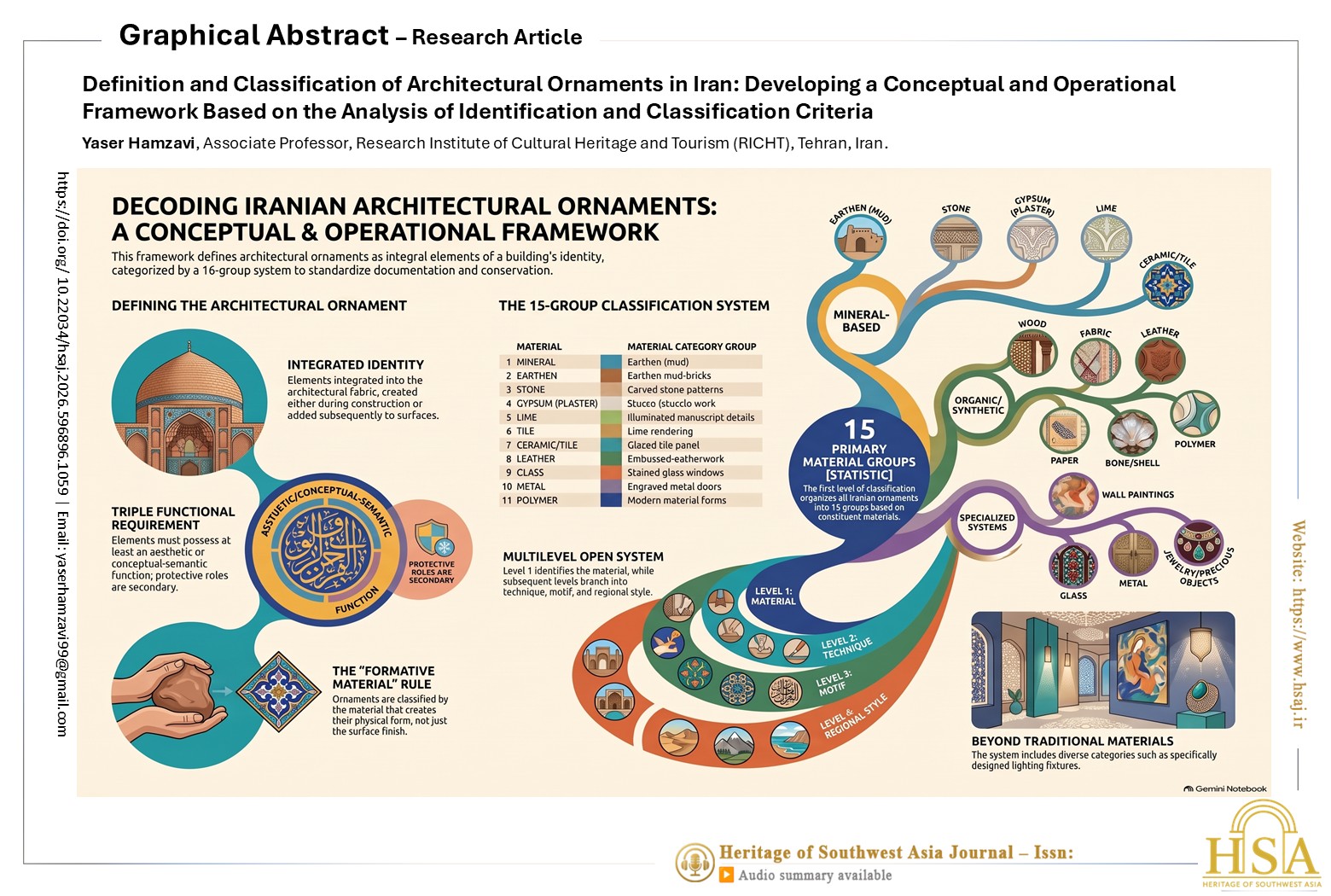
Architectural ornaments constitute an important part of the physical, aesthetic, historical, and semantic identity of Iranian architecture. However, the extensive diversity of materials, techniques, methods of execution, and the relationship of these elements to architecture has resulted in the concept of “architectural ornament” being used with inconsistent boundaries and definitions in existing studies, while a comprehensive and multilevel classification system has yet to be established. This study aims to operationally define “architectural ornament” and develop a framework for classifying architectural ornaments in Iran. In terms of purpose, the research is developmental-conceptual, and methodologically it is based on the study and comparative analysis of the literature on the concepts of architectural ornament and decoration, as well as an examination of existing studies on architectural ornaments in Iran. Accordingly, “relationship to architecture,” “mode of formation,” and “function” were identified as the principal components determining the conceptual scope of architectural ornament, while “predominant material and constituent material, together with the predominant nature of the ornament,” was selected as the basis for the first level of classification. The proposed definition considers an architectural ornament to be an element associated with architectural surfaces, components, or fabric that is either created concurrently with the formation of the architecture or executed or added to it subsequently, and that possesses at least an aesthetic or conceptual-semantic function. A covering-protective function may also fall within the scope of architectural ornament when accompanied by either of these two functions. Based on this framework, Iranian architectural ornaments were organized into 16 major groups at the first level, with the possibility of developing more specialized classes and subclasses based on technology, execution technique, form, motif, location, historical period, and regional characteristics. The findings indicate that distinguishing between criteria that determine the concept and criteria used for classification, together with organizing these criteria within an open hierarchical structure, can provide a coherent basis for the identification, documentation, study, and conservation of architectural ornaments in Iran.
Graphical Abstract
Highlights

· The criteria for defining the conceptual scope of architectural ornamentation, namely, its relationship to architecture, mode of formation, and function, are clearly distinguished from the criteria used for its classification.
· A comprehensive 16-fold classification has been developed at the primary level, based on the predominant material and medium, as well as the overall nature of the work.
· The proposed framework is designed as an open, hierarchical, and expandable classification system, allowing for the incorporation of additional subcategories based on technology, technique, and historical period.
· The term “architectural ornamentation” is proposed in place of “architectural-associated decorations” to emphasize the intrinsic, physical, and identity-related roles of these elements.
· The formative material of the motifs is established as the primary criterion for determining the principal type of ornamentation. Surface or supplementary layers, such as paint and gilding, do not alter its primary nature.
· For boundary cases and movable objects, such as chandeliers and jewelry, a stable and deliberately designed relationship with the physical and semantic system of the building is proposed as the criterion for identifying them as architectural ornamentation.
· Given changes in function over time, the study emphasizes the need to distinguish between the original function of an object at the time of its creation and its subsequent function or status in historical and conservation studies.
Keywords
Subjects