
نوع مقاله : مقاله پژوهشی
چکیده تصویری
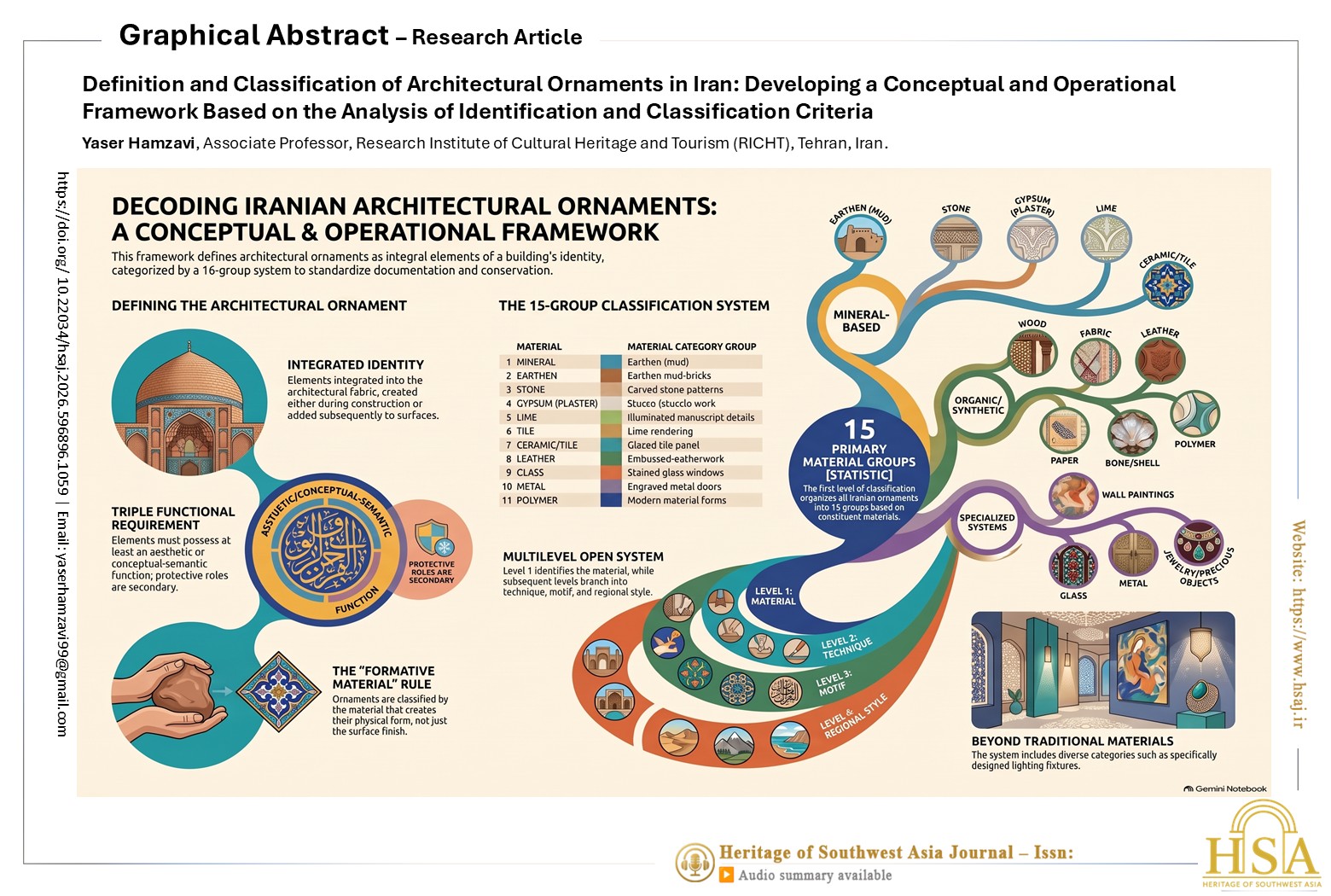
تازه های تحقیق

1. Introduction
Architectural ornaments are among the most important carriers of historical, artistic, technical, social, and cultural values in historic buildings and play a fundamental role in shaping the identity, legibility, and perceptual quality of architecture. Despite this significance, the concept of “architectural ornament” has not always been used with consistent and clearly defined conceptual boundaries in architectural, art, and conservation and restoration studies. In many studies, architectural ornaments have largely been regarded as synonymous with embellishment and aesthetics; however, a wide range of elements associated with architecture may, in addition to aesthetic functions, possess conceptual-semantic and, in some cases, covering-protective functions, while some have been an inseparable part of the formation or fabric of architecture from the outset of a building’s construction. This conceptual ambiguity can affect the identification, classification, documentation, and analysis of ornaments and, ultimately, decision-making concerning their conservation and restoration.
From this perspective, providing a clear, distinguishable, and operational definition of architectural ornament is not merely a terminological or theoretical issue; rather, it can provide a common basis for research, documentation, and the management of this component of architectural heritage. Defining the conceptual boundaries of ornaments enables the systematic identification of their diverse range, the development of coherent documentation frameworks, the establishment of specialized databases and atlases, and the development of a shared terminology among researchers in architecture, archaeology, art, technology studies, pathology, conservation, and restoration. Such a framework can also provide an appropriate basis for comparative studies across different periods, regions, and architectural traditions.
The significance of this issue is also considerable in the fields of technological studies and pathology. A precise understanding of the nature and boundaries of architectural ornaments enables a more systematic examination of the relationships among materials, construction technology, execution techniques, architectural substrate, and deterioration processes. This issue has direct implications for conservation and restoration, as determining the type, extent, and necessity of intervention without understanding the nature, position, and values of an ornament within the architectural system of a building may result in the loss of historical and technical evidence, alteration of authentic characteristics, or disruption of the relationship between the ornament and the architecture. Therefore, an accurate definition of architectural ornament can, in addition to providing a framework for identification and classification, serve as a basis for a value-based, evidence-based, and authenticity-sensitive approach to the conservation and restoration of architectural ornaments. This need is particularly significant in the context of Iran’s historic architecture. The extensive geographical diversity, variety of materials, complexity of traditional technologies, and diversity of artistic and architectural modes of expression across different periods have produced a broad and multilayered range of architectural ornaments. Numerous studies have examined various types, materials, and techniques of architectural ornaments in Iran; nevertheless, a substantial proportion of these studies have focused on a particular type, material, technique, historical period, or specific subject, while the criteria used for the identification and classification of ornaments have often been selected according to the subject and objectives of the individual study. Consequently, within the existing literature, a consistent and operational definition of the concept of architectural ornament, as well as a clear distinction between criteria for identifying ornaments and criteria for classifying them, has received comparatively limited formulation. Furthermore, a comprehensive, multilevel, open, and extensible framework capable of encompassing the diversity of Iranian architectural ornaments in terms of materials, technologies and execution techniques, position and relationship to architecture, historical and regional characteristics, and other distinguishing dimensions has received comparatively limited attention. Accordingly, developing a framework capable of integrating these dimensions within a coherent conceptual and operational system represents both a research and practical necessity.
Accordingly, the present study aims to develop a conceptual and operational framework for defining and classifying architectural ornaments in Iran. To this end, the theoretical literature and studies related to the concept of architectural ornament and approaches to its identification and classification are first examined. The criteria proposed in existing sources and studies are then extracted, categorized, compared, and analyzed in order to distinguish identification criteria from classification criteria and to determine the components that contribute to defining the conceptual boundaries of architectural ornament. Based on this analysis, a proposed definition of “architectural ornament” is formulated, and a set of identification and classification criteria is developed to organize its instances. Finally, a multilevel and extensible framework for the classification of architectural ornaments in Iran is presented. This framework can provide a basis for the identification and documentation of architectural ornaments, technological and pathology studies, value assessment, and the development of conservation and restoration strategies.
2. Research Method and Process of Developing the Conceptual Framework
The present study is developmental-conceptual in terms of its purpose and was conducted with the aim of developing an operational definition of “architectural ornament” and proposing a framework for the classification of architectural ornaments in Iran. Over the past 25 years, the author has conducted numerous field investigations and studies on Iranian architectural ornaments and, through these studies, has observed that the diversity of architectural ornaments in Iran is considerably greater than what is documented in the existing written sources. At the same time, no researcher has so far addressed this subject specifically and systematically as a distinct research topic. Nevertheless, a number of scholars have published works that address architectural ornaments more generally. It can be argued that none of these books and sources is comprehensive from the perspective adopted in the present study (Maki-Nejad, 2008; Kiani, 1995; Kiani, 1997; Kiani, 2000; Khodadadi & Bozorgmehri, 2011; Hamzavi & Aslani, 2023; Pope & Ackerman, 2008; Pope, 1991; Pirnia, 1990; Pirnia, 2004; Ettinghausen & Grabar, 1999; Blair & Bloom, 2006; Hillenbrand, 2008; Godard et al., 1992; Grabar, 2000; Hill & Grabar, 1996; Papadopoulo, 1989; Ferrier, 1995; Necipoğlu, 2000; Michell, 2001; Hamzeh-Loo, 2002; Hamzeh-Loo, 2007; Zabti Jahromi, 2010; Masjedi-Khak et al., 2018; Ebrahimi et al., 2024; Javadi, 1984; Omranipour, 2005). At this stage, in addition to identifying different types of ornaments, the principles and criteria employed in defining and classifying them were also examined.
In the second step, the existing classification systems were compared in terms of their classification basis, comprehensiveness, distinctiveness, and applicability to architectural studies and conservation and restoration. Based on this analysis, the principal criteria for defining architectural ornament, including its relationship to architecture, mode of formation, function, and identifiability and amenability to study, were extracted. These criteria constituted the basis for the proposed definition.
In the third step, various criteria for classifying architectural ornaments were examined, and predominant material and constituent materials, together with the nature and execution characteristics of the ornament, were selected as the basis for the first level of classification, because this criterion is directly related to construction technology, execution methods, and technological and conservation studies. Accordingly, the identified types were organized into 16 major groups, with the possibility of developing more specialized classes and subclasses at subsequent levels.
Finally, the proposed framework was reviewed in terms of conceptual coherence, comprehensiveness, distinctiveness, extensibility, and applicability to studies of identification, documentation, technological analysis, pathology, and conservation and restoration. Accordingly, the 16-group classification is proposed as the first level of an open, multilevel system rather than as a final and immutable system. Broader validation can be undertaken in future studies through testing the framework on diverse examples of Iranian architecture and through expert evaluation.
A comparative examination of the literature indicates that various criteria, including materials, technology and technique, form and motifs, location, function, historical period, and relationship to architecture, have been used independently or in combination in previous studies. However, these criteria have not been systematically organized within a unified, multilevel system specifically designed for the comprehensive identification and classification of architectural ornaments in Iran, and all classifications presented in the Persian-language literature are incomplete. Therefore, the problem addressed by the present study is not the invention of new individual criteria, but rather the integration and hierarchical organization of existing criteria and their transformation into a conceptual and operational framework suited to the needs of research on Iranian architectural ornaments. Accordingly, in the present study, “relationship to architecture,” “mode of formation,” and “function” are employed to determine the conceptual scope of architectural ornament, while “predominant material and constituent materials, together with the nature and execution characteristics” are selected as the basis for the first level of classification. Other characteristics, including construction technology, execution technique, form, motifs, location, historical period, and regional characteristics, can be employed at subsequent levels. Therefore, the proposed 16-group classification does not claim absolute superiority over previous systems; rather, it provides a framework for the initial integration and standardization of the classification terminology of Iranian architectural ornaments, with the capacity for further development and revision at more specialized levels.
3. Basis and Rationale of the Proposed Definition
The proposed definition of architectural ornament derives from a review and comparative analysis of the literature concerning the concepts of ornament, architectural ornament, and decoration, as well as studies conducted on architectural ornaments in Iran. Examination of these sources indicates that ornament cannot be regarded merely as synonymous with “embellishment” or an “aestheticizing element” of architecture, because many theoretical approaches have considered the relationship of ornament to architecture, its connection to its substrate and support, its material and technology, its role and function, and its historical and semantic dimensions (Riegl, 1992; Gombrich, 1979; Trilling, 2003; Ahani et al., 2017; Van Eck, 2020). Studies of Iranian architecture likewise demonstrate that the diversity of materials, techniques, and methods of execution of decorative elements places many of these elements at the intersection of construction, covering, function, and aesthetic expression. Based on this examination, four principal components were identified and organized into a coherent framework for formulating the proposed definition: the relationship of the ornament to architecture, function, the relationship between material and technology and the ornament, and the operational applicability of the definition. These components subsequently formed the basis for determining the conceptual scope of architectural ornament and developing the proposed classification system.
The first basis is the relationship between the ornament and architecture. An ornament does not emerge in isolation; rather, it establishes a direct relationship with architectural surfaces, components, or fabric. This relationship may be formed through its contemporaneity with the construction process, meaning that the element is part of the construction or formation of the architecture from the outset, or it may be executed on or added to the architectural fabric after its formation. Considering both conditions prevents the concept of ornament from being restricted to merely appended elements and enables the identification of elements that have simultaneously served architectural and ornamental roles during the construction process. Emphasis on the relationship of an element to its architectural substrate and support is also consistent with part of the theoretical literature concerning the distinction between ornament and decoration; within this literature, the degree of an element’s integration with architecture has been regarded as an important criterion for distinguishing between the two concepts. In a specialized terminology system such as the Getty Art & Architecture Thesaurus (Getty AAT), architectural ornaments are positioned within the hierarchy of architectural surface elements, thereby emphasizing their relationship to architectural elements (Getty Research Institute, n.d.).
The second basis is function. In the proposed definition, the presence of at least one of the two principal functions, conceptual-semantic and aesthetic, as well as a secondary covering-protective function, constitutes a condition for placing an element within the scope of architectural ornaments. These functions may occur independently or simultaneously within a single ornament. Accordingly, merely being located on an architectural surface or within the architectural fabric is not sufficient for an element to be designated as an “ornament”; rather, the element must possess at least one of the specified functions. On the one hand, this criterion enables a conceptual distinction between general architectural elements and architectural ornaments; on the other hand, it prevents the concept of ornament from being reduced to aesthetics alone.
The third basis concerns the relationship among material, technology, and ornament. An architectural ornament is not merely a visual phenomenon; in many cases, it is the outcome of material selection, an understanding of material properties, construction technology, execution skills, forming methods, and the manner in which it is connected to the architectural substrate. Therefore, studying an ornament without considering its material, structure, production technology, and method of execution provides an incomplete understanding of its nature. This issue is also evident in historical studies of Iranian architectural ornaments, where brick, plaster, earthenware, tile, wood, and other materials each encompass distinct sets of techniques and methods of execution. Accordingly, the proposed 16-group classification considers materials and constituent materials, together with the predominant nature of the work, as the basis of the first level, thereby enabling a transition from the conceptual definition toward specialized study of the materials, techniques, technologies, and diverse types of Iranian architectural ornaments. At subsequent levels, this classification can be further developed based on characteristics such as material composition, execution technology and technique, forming method, layered structure, motifs, and physical and technical characteristics.
The fourth basis is the operational applicability of the definition. A scientific definition in the field of cultural heritage is sufficiently effective when, in addition to establishing the conceptual boundaries of a phenomenon, it can also be applied in actual processes of investigation and conservation. From this perspective, the proposed definition should enable its use in identification, documentation, classification, technological and pathology studies, value assessment, monitoring, and decision-making concerning conservation and restoration interventions. Therefore, the present definition has not been formulated merely to establish the meaning of a term; rather, it has been developed with an operational approach and with the aim of creating a framework applicable throughout the processes of investigating, documenting, assessing, and conserving architectural ornaments.
Accordingly, the first three bases determine the conceptual boundaries and identification criteria of architectural ornaments, while the fourth basis establishes the applicability of the definition within research and conservation processes. The result of this combination is a definition that, on the one hand, encompasses the relationship of the ornament to architecture and its material and technological characteristics and, on the other hand, by establishing explicit criteria for identification, enables the transformation of the theoretical concept of ornament into an operational framework for classification and conservation.
4. Definition and Classification of Architectural Ornaments in Iran
A. Definition
An architectural ornament is an element associated with architectural surfaces, components, or fabric that is either created concurrently with the formation or construction of the architecture as part of its construction or formation, or executed on or added to the architectural structure and fabric after their formation, and that possesses at least one of the aesthetic or conceptual-semantic functions. These functions may be present independently or simultaneously within a single ornament. Another function is the covering-protective function. If the surfaces of interior or exterior architectural spaces are formed by a layer that serves only a covering-protective function, this function alone cannot place that layer within the category of architectural ornaments. The layer must also possess either a conceptual-semantic or an aesthetic function in order to be considered an architectural ornament. Therefore, an element that possesses none of these functions is not considered an architectural ornament merely because it is located on an architectural surface or within the architectural fabric.
It should be noted that the function of architectural ornaments is not necessarily a fixed and unchangeable characteristic and may change, diminish, or disappear over time under the influence of physical transformations, changes in the use of the building, social and cultural conditions, semantic transformations, and even conservation and restoration processes. Therefore, in identifying and assessing architectural ornaments, a distinction should be made between their function at the time of their formation and their function or status at the time of study. An element may have possessed an aesthetic or conceptual-semantic function at the time of its creation and, according to the present definition, may have been considered an architectural ornament; however, over time, as a result of changes in use, the loss of part of the work, changes in the visual or semantic system of the building, or social transformations, it may have largely lost that function.
Nevertheless, the loss of an original function does not necessarily mean that the element falls outside the domain of architectural ornaments, because the element itself may constitute a historical, artistic, and technical witness and may possess conservation value as part of the authenticity and identity of the building. Conversely, an element may originally have possessed only a structural, covering, or protective function and therefore may not have been considered an architectural ornament at that time, but in subsequent periods, as a result of cultural, aesthetic, or semantic changes, it may have acquired a new status and come to be recognized as part of the ornamental system of the building.
Therefore, whether an element constitutes an architectural ornament cannot be determined solely on the basis of its current or original function; rather, its historical development and its relationship with architecture over time must also be taken into consideration. Accordingly, in historical and conservation studies, the identification of an architectural ornament should take into account the time of its formation, its original function, subsequent historical transformations, and its later function or meaning. This approach prevents both the exclusion of historical elements merely because they have lost their original function and the unjustified designation of elements as ornaments solely on the basis of contemporary interpretations.
Iranian architectural ornaments can be classified at the first level into 16 major groups according to their predominant material, constituent materials, and predominant nature. Each group can, depending on its materials, construction technology, preparation and processing methods, forming and execution techniques, and other technical and physical characteristics, be further divided into more specialized classes and subclasses.
A review of the literature indicates that the concept of architectural ornament has been formulated from different perspectives in various sources, and that no single universal definition has yet been established. In the theoretical literature on architecture, the distinction between ornament and decoration has long been a subject of theoretical debate. Some studies regard ornament as an element more closely and persistently integrated with architecture, whereas decoration is understood as a broader concept referring to the arrangement and embellishment of architectural environments (Ahani et al., 2017; Van Eck, 2020). In the Getty Art & Architecture Thesaurus, architectural ornaments are likewise positioned within the hierarchy of architectural elements and under the category of architectural surface elements. These approaches emphasize the importance of the relationship between the ornamental element and its architectural context.
With regard to the English equivalent of the Persian term “آرایههای معماری” a distinction should be made between the two terms ornament and decoration. The term ornament generally refers to ornamental and decorative elements that are associated with and integrated into an architectural work, whereas decoration may have a broader meaning and can refer to elements that are not necessarily an inseparable part of the structure and identity of architecture and that may be altered or removed. Accordingly, considering the nature, integration, and position of ornamental elements within Iranian architecture, the term Architectural Ornaments is adopted in this study as the more appropriate and comprehensive equivalent of “آرایههای معماری”. The singular form Architectural Ornament may be used when referring to an individual element.
B. Distinction between “Architectural Ornaments” and “Architecturally Associated Decorations”
In a substantial body of earlier Persian-language specialist literature, the term “تزئینات وابسته به معماری” (“architecturally associated decorations”) has been used to refer to decorative elements associated with buildings and has become common, particularly in studies of the historical architecture of Iran. Nevertheless, from a terminological and conceptual perspective, the term “آرایههای معماری” (“architectural ornaments”) appears to be more precise and appropriate for expressing the scope addressed in the present study.
First, the term “تزئینات” has an Arabic origin, whereas “آرایه” is its Persian equivalent and has a long history in Persian literature in expressing the concepts of adorning and ornamenting. The use of the term “آرایه” is therefore more consistent with the Persian language and makes it possible to establish a coherent and indigenous specialist terminology within architectural studies.
Second, the expression “وابسته به معماری” (“architecturally associated” or “dependent on architecture”) does not adequately represent the conceptual status of these elements. The term “وابسته” may imply that such elements are external and appended phenomena that are merely attached to architecture, whereas many architectural ornaments have been integral to the construction process, spatial organization, and physical identity of a building from the very beginning of its formation. Just as architectural expressions such as “architecturally associated foundation” would not be used to describe a foundation, wall, roof, or other architectural component, many ornamental elements should likewise not be understood merely as dependent elements; rather, they constitute parts of architecture itself and contribute to the formation of the visual experience, meaning, construction technology, and identity of the work.
Nevertheless, for the purposes of the present study, the term “Architectural Ornaments” has been selected as the principal term because it emphasizes the intrinsic position of these elements within architecture, encompasses a scope broader than mere decoration, and is more consistent with the proposed definition and classification system. The author therefore proposes that specialists use the terms “architectural ornament” and “architectural ornaments” consistently in both scholarly discourse and writing.
C. Diagram of the Sixteen-Group Classification of Iranian Architectural Ornaments
Based on the proposed definition, Iranian architectural ornaments can be placed, at the first level of a preliminary classification system, into 16 major groups (Fig. 1): At the first level, this classification is based on the predominant material and constituent materials, together with the predominant nature and execution characteristics of the ornament. Each major group can subsequently be divided into more specialized classes and subclasses according to factors such as material type, compositional characteristics, preparation and processing methods, construction technology, forming methods, execution techniques, stages of ornament production and execution, degree of projection or relief, and physical and technical characteristics. From this perspective, the 16-group classification constitutes a foundational system for moving from the general identification of ornaments toward a specialized, multilevel classification system.
This classification system has been proposed with the aim of establishing a comprehensive framework for identifying and organizing the extensive diversity of Iranian architectural ornaments. From this perspective, the present classification is not merely a list of ornament types; rather, it can provide a basis for establishing a common language in architectural ornament studies and for developing national documentation systems, databases, and specialized atlases.
The inclusion of Wall Paintings as an independent group reflects their particular characteristics as a visual and execution system associated with an architectural substrate and prevents the diversity of techniques and materials employed in wall paintings from obscuring their distinct nature in architectural and conservation studies. This classification constitutes an open and extensible system and can be expanded and revised as technological studies advance, traditional and modern technologies are identified, and previously less-known examples and types come to light. Accordingly, the proposed 16 groups should be regarded as the first level of a multilevel classification system, rather than as the endpoint of the classification of Iranian architectural ornaments.

Figure 1. Classification diagram of Iranian architectural ornaments based on the type of materials and constituent materials.
5. Borderline Cases and Issues for Consideration within the Proposed Framework
The proposed framework has been developed with the aim of defining the conceptual boundaries of architectural ornaments and establishing a coherent basis for their classification. Nevertheless, when dealing with certain borderline elements and situations, determining whether they fall within the domain of architectural ornaments is not always self-evident. Therefore, in order to examine the explanatory and practical applicability of the framework, the proposed criteria need to be considered in relation to cases that lie at the boundary between an architectural ornament, a building element, a covering layer, a movable object, or other elements associated with architecture. This examination is not intended to provide definitive or final validation of the framework; rather, it is intended to clarify its conceptual boundaries, reveal the capacities and limitations of the proposed definition, and demonstrate how the identification and classification criteria can be applied in complex situations.
A. Wall Paintings: At first glance, it may appear that the basis for naming the groups in this classification is, in all cases, the constituent material, and that Wall Paintings constitute an exception to this rule. This, however, is not the case. If Wall Paintings were to be named solely according to their constituent material and in accordance with the titles of the other groups, terms such as “Pigment-Based Ornaments” or “Colorant-Based Ornaments” could have been proposed, since the principal material involved in their formation is the pigment and paint layer. However, pigments and paint layers may also occur as supplementary layers in other types of architectural ornaments, such as painted plaster ornaments. Consequently, selecting a designation based solely on material would not have provided a clear and distinctive characteristic for this type and could have resulted in conceptual overlap among the groups.
Therefore, in order to avoid ambiguity and to use a clear and comprehensible designation for both audiences and specialists, the term “Wall Paintings” has been selected for this type. Accordingly, the difference in the designation Wall Paintings does not indicate a difference in the logic underlying the selection of this group in comparison with the other classification groups; rather, it results from the need to select a more distinctive and expressive designation for a particular type. In this classification, all groups at the first level have been identified and named on the basis of their predominant material and constituent materials, together with the predominant nature of the ornament. Where the nature of the work requires a more appropriate and precise designation, this characteristic has also been taken into consideration in naming the group.
B. Jewelry and Decorative Objects: Since ancient periods, written and artistic evidence has documented the use of gemstones and decorative objects in the adornment and enhancement of spaces and architectural elements in Iran. Persian literary texts likewise contain evidence of the use of gemstones and precious materials in the adornment and formation of architectural elements. For example, Ferdowsi, in his description of the Palace of Khosrow, refers to a “gem-encrusted iwan” and vaults adorned with silver, gold, and various kinds of gemstones (Ferdowsi, 2007).
Unlike the temporary decoration of a space for the celebration of a festival or ritual, this description refers to the character and ornamentation of the building itself and can therefore be regarded as literary evidence for the use of gemstones and precious objects as architectural ornaments.
Similarly, in the account of the reign of Bahram Gur, following the defeat of the Khagan of China, Bahram orders that the Khagan’s crown be brought to him and that the gemstones set within it be removed and incorporated into the wall of a fire temple (Ferdowsi, 2007).
These verses are particularly significant because the gemstones of a decorative object—a crown—are removed from their original context and incorporated into the wall and architectural elements of a fire temple. They therefore constitute an explicit example of the connection between jewelry and decorative objects and architecture, and of their transformation into a permanent part of the ornamentation of a building.
Likewise, in monuments such as Persepolis, the use of gemstones and jewelry in the representations of kings in the reliefs constitutes part of the artistic evidence concerning the status and significance of such elements within the culture and art of Iranian architecture. Unfortunately, at Persepolis, only traces of these architectural ornaments remain visible, while these valuable elements have been lost.
In these works, during the execution of the reliefs, the areas intended to accommodate gold leaf or gold wire, as well as gemstones, were carved slightly deeper so that, after these ornaments were placed in their designated positions, they would appear fully integrated and flush with the surrounding stone surface. This particular type of ornament was generally applied to crowns or headdresses, bracelets, and necklaces. To attach these elements, holes were usually made in the stone, and metal sheets and gemstones were installed on the stone in such a way that they would be regarded as part of the work while maintaining its visual and material integrity (Fig. 2).


Figure 2. Traces remaining from jewelry used as architectural ornaments, Persepolis
Another example in this regard is provided by jewelry and decorative objects that can be observed as architectural ornaments within the main domed chamber of the Razavi Shrine. To display a selection of valuable and highly significant historical objects, niches or frames have been designed and constructed within the wall, and these precious decorative objects have been installed inside them and ultimately covered with glass. In this way, these decorative objects and gemstones have been transformed into architectural ornaments through their integration into the architectural setting (Fig. 3).


Figure 3. Precious historical decorative objects and jewelry functioning as architectural ornaments, main domed chamber of the Razavi Shrine
C. Movable Objects Functioning as Architectural Ornaments: Whether a decorative object is considered movable or an architectural ornament cannot be determined solely based on its physical capacity to be moved; rather, it also depends on the nature and degree of its relationship with architecture. An object that is merely placed within an architectural space and can be detached and used in another location without altering its nature, structure, or the architectural system is considered a movable object. By contrast, if an object has been designed specifically for a particular architectural setting from the outset (in which case the object and the architectural work are usually created concurrently), has been formed in a permanent relationship with the architecture, or has, through historical processes, become part of the ornamental, conceptual, or aesthetic system of a specific building, and if its position, manner of installation, and relationship with the architecture play a role in the identity and interpretation of the work, it may, within the framework of the present study, be regarded as an architectural ornament.
Accordingly, the distinguishing criterion is not merely physical movability, but rather the “relationship of the object to architecture” and the extent to which it is integrated into the physical, aesthetic, and semantic system of the building. In other words, a decorative object can be considered an architectural ornament when it has established a stable, meaningful, and deliberately designed relationship with the architecture, and when its presence forms part of the formation, interpretation, aesthetics, or meaning of the architectural space. However, if an object is merely placed within an architectural space and can be removed from the building and used in another space without fundamental alteration to the architecture, it is essentially a movable object, even if it is highly beautiful and decorative.
Example: An ordinary chandelier in a historic palace that has simply been suspended from the ceiling for lighting and aesthetic purposes and can be dismantled and installed in another palace or museum is a movable object rather than an architectural ornament. However, if, in a historic building, the chandelier was designed and produced specifically for that space from the outset, and its installation location, dimensions, form, ornamentation, composition, and method of attachment to the ceiling and architectural space were incorporated into the design of the building, such that it became an integral part of the ornamental and semantic system of that space, it may, within the framework of the definition proposed in this study, be regarded as an architectural ornament.
The Morvarid Palace in Karaj, a modern architectural work from the Pahlavi period, provides a specific example in which the lighting fixtures were designed and executed specifically for the building. Accordingly, the chandeliers of this palace can be considered architectural ornaments (Fig. 4).


Figure 4. Lighting design in modern Pahlavi-period architecture, Morvarid Palace, Karaj
D. Formative Material of the Architectural Ornament: In this study, the author argues that the type of an architectural ornament should be determined based on the material that forms it. At first glance, this position may appear self-evident; however, closer examination reveals that some architectural ornaments cannot readily be assigned to a single specific type. To clarify this issue, three examples are presented.
First example: In desert regions, particularly in the Yazd region, there are prominent ornaments whose form and relief were created using mud. In other words, the artist or craftsman used mud or kāhgel (mud plaster) to create a form or motif on the wall surface. Subsequently, two situations may have occurred. In the first, a very thin layer of plaster, approximately one millimeter thick, was applied over the kāhgel surface, followed by a preparatory or priming layer, usually made of Calcium Carbonate Powder, applied over it. The ornament was either completed at this stage or subsequently covered with a paint layer. In the second situation, the preparatory layer was applied directly onto the mud. In both cases, because the relief motifs were formed using mud, the ornament belongs to the category of Earthen Ornaments, regardless of the nature of the very thin overlying layers (Fig. 5).
Second example: Another example is the Lāyeh-chini ornament. Based on technical studies of the constituent materials of this type of ornament, it has been established that more than half of its mineral component consists of plaster, while a smaller proportion consists of red clay (gel-e Hormoz or Armenian bole). Its organic component consists of animal glue (Hamzavi, 2024). In addition, gold leaf or gold-colored foil was usually adhered to the surface of the Lāyeh-chini ornament; consequently, the final appearance of the motifs was golden in color (Fig. 6). Given the predominance of plaster in the constituent material of Lāyeh-chini, and considering that the material that forms the motifs is the Lāyeh-chini material itself, while the gold-colored foil is merely a supplementary and finishing layer, Lāyeh-chini ornament is classified under Plaster Ornaments.
Third example: In many historic buildings in Iran in which plaster ornaments were executed, some parts of the plaster ornaments were occasionally painted at the time of their creation in order to enhance their visual effect and aesthetic quality (Fig. 7). In such cases, the layer visible at the final surface may have been a paint layer or gold leaf. If the surface layer alone were taken as the criterion, these works might be classified under Wall Paintings. However, in this study, the author argues that the material forming the motifs should serve as the basis for determining the type of an architectural ornament. Therefore, motifs or inscriptions executed in plaster mortar are classified as Gypsum-based Ornaments, whether they have remained in their original form or whether, at a later stage, a supplementary layer of paint or gold leaf was applied over their surface. In other words, painting or gilding, when it constitutes merely a supplementary layer applied over a plaster motif, does not alter the nature of the formative material and, consequently, does not change the primary type of the ornament.


Figure 5. Earthen ornament, mihrab of the Jameh Mosque of Fahraj
Figure 6. Gold-leafed Lāyeh-chini ornament, ceiling of the dome of the Bethlehem Church, Isfahan
Figure 7. Painted and Gilded Plaster Relief Inscription, the Pir-e Baqran Shrine, inscription dated 703 AH
6. Conclusion
The concept of “architectural ornament” in the study and conservation of historic architecture is a multilayered concept that cannot be reduced merely to the decoration or aesthetic quality of a building. The diversity of Iranian architectural ornaments demonstrates that these elements are formed in relation to materials, technology, architectural fabric, meaning, and environmental conditions, and may simultaneously possess conceptual, aesthetic, and, with certain limitations, covering-protective functions. Accordingly, defining the boundaries of this concept is an important prerequisite for establishing coherence in studies related to architectural ornaments and their conservation. Based on an analysis of the relevant literature and through the combination of three principal components—relationship to architecture, mode of formation, and function—the definition proposed in this study provides a framework for identifying and distinguishing architectural ornaments. This definition encompasses both ornaments formed concurrently with the construction of a building and those executed on or added to the architectural fabric after its formation. At the same time, by specifying three types of function, it provides a clear criterion for distinguishing ornaments from other architectural elements. In this way, the concept of ornament moves beyond a merely descriptive designation toward a concept that can be applied in research and conservation processes. In this context, operational applicability, as a complementary component, concerns the possibility of applying the definition in the processes of identification, documentation, analysis, and conservation.
The distinctive contribution of the proposed framework, compared with many previous approaches, does not lie in introducing entirely new criteria, but rather in combining, distinguishing, and organizing existing criteria within a coherent, hierarchical, and multilevel framework focused on Iranian architectural ornaments. Within this framework, the relationship of the ornament to architecture, its mode of formation, and its function define the conceptual boundaries of the subject; subsequently, predominant material and constituent materials, together with the predominant nature of the work, constitute the basis for classification at the first level. At subsequent levels, characteristics such as technology, execution technique and method, form and motif, location, historical period, and regional characteristics can be employed to distinguish more specialized classes and subclasses. From this perspective, the proposed framework seeks to establish a systematic relationship among the conceptual definition, identification, classification, and specialized applications of architectural ornaments.
The proposed 16-group classification constitutes the first operational level of this framework. This classification enables the initial organization of the material, technical, and executional diversity of Iranian architectural ornaments and can serve as a basis for developing more specialized classifications at subsequent levels. The advantage of this structure is that it does not restrict classification to a fixed and closed list, but rather treats it as an open and extensible system, allowing classes and subclasses to be added, subdivided, or revised as knowledge of Iranian architectural examples increases. Such a structure can subsequently be used for developing specialized terminology, establishing databases, preparing atlases of architectural ornaments, and developing coherent documentation systems.
The implications of this framework for conservation and restoration also extend beyond a purely theoretical classification. A clear definition of the subject of conservation provides a basis for identifying values, diagnosing and analyzing deterioration, and examining factors contributing to deterioration, and selecting appropriate intervention strategies. Accordingly, the proposed framework can strengthen the relationship between historical and artistic studies and technological studies, deterioration assessment, conservation, and restoration, and can facilitate decision-making in which the material, technology, authenticity, function, and relationship of the ornament to architecture are considered simultaneously. Furthermore, distinguishing between the material that forms the ornament and supplementary layers can be useful in identifying and classifying works composed of multiple materials or layers, including painted or gold-leafed plaster ornaments.
Nevertheless, the present framework should not be regarded as a closed, final, and immutable system. The present study seeks to formulate a conceptual and operational framework at an initial stage rather than to establish a definitive and final system for all types of Iranian architectural ornaments. Therefore, its empirical validation and further development require testing the framework on diverse examples of Iranian architecture, comparative examination of different historical periods and regions, analysis of borderline cases, and expert evaluation by researchers and specialists in relevant fields. This process may lead to the refinement of criteria, redefinition of certain conceptual boundaries, and further development of the different levels of classification.
Such an approach is consistent with the nature of conceptual frameworks, as these frameworks are developed through processes of conceptual analysis and synthesis and are capable of being revised and refined on the basis of data, new literature, and expert evaluation. Overall, the principal finding of the present study is the formulation of an operational definition and a multilevel framework for the identification and classification of Iranian architectural ornaments. By distinguishing between criteria that determine the conceptual scope and criteria used for classification, this framework enables a more coherent approach to the extensive diversity of Iranian architectural ornaments.
Acknowledgments
The author wishes to express his sincere appreciation to Dr. Hesam Aslani for his valuable guidance over the past twenty years.
Financial and Non-Financial Support
This research was conducted without financial or non-financial support.
Declaration of Competing Interests
The author declares that there are no competing interests.
Data Availability
The raw data are retained by the author and are available upon request by correspondence.
